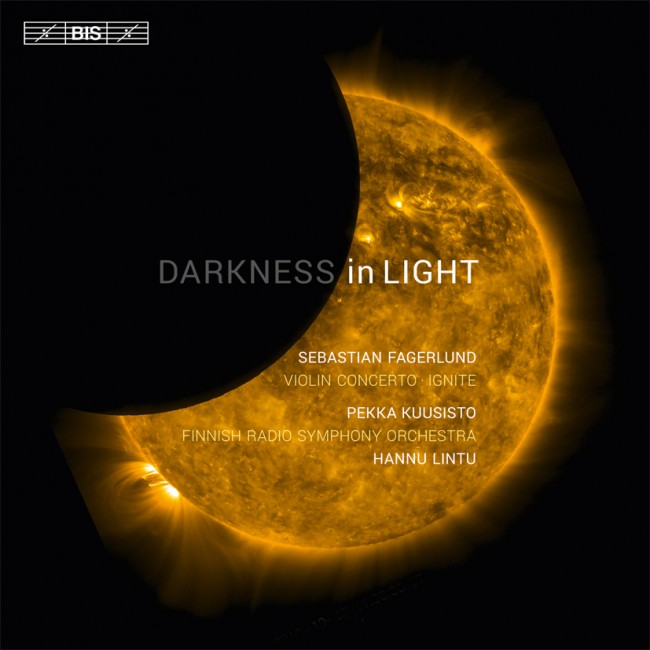
Album du jour: Sebastian Fagerlund, “Darkness in Light”

4930886-origpic-160576

43 year-old Sebastian Fagerlund is one of the rising composing stars of Finland, a country whose per-capita production and consumption of classical music is something we Americans could only dream of.  Well, to paraphrase the old song, five-and-a-half million Finns can’t be wrong.  So, let’s give this new recording of Fagerlund’s works from Sweden’s invaluable BIS label a spin and see whether we hear what they hear — if one were able see what one hears, that is.

For those of us not blessed (or cursed) with synesthesia, describing music like this is a tricky business, though annotator Susanna Välimäki gives it a pretty good go in the album booklet:

Fagerlund’s music is characterized by incessantly flowing, layered soundscapes, in which forceful, angular figures and static, brooding motifs trace out strong lines or exist as independent blocks. This results in the impression of inexor able processes, natural or mechanical, indifferent to those who find themselves at the centre of the events.

There’s plenty more description where this comes from in the booklet, which you can download in pdf form here.  My recommendation, however, is as always, listening first, reading later.

Fagerlund_web-760x507

Up first is Fagerlund’s Violin Concerto, subtitled “Darkness in Light,” composed in 2012 for Finnish violinist Pekka Kuusisto, the soloist in the present recording.  In three movements following the classic fast-slow-fast pattern and lasting roughly a half-hour, Fagerlund’s Concerto is comparable in size and shape to standard repertoire concertos by Mendelssohn, Bruch, Tchaikovsky, Sibelius, Barber, et al.  — a lineage into which “Darkness in Light,” with its traditional design and tonal language, fits unabashedly but not obsequiously.

From its arresting opening to its perhaps surprising conclusion (don’t give it away!), the Concerto never for a moment flags in tension or intensity.  The solo violin writing, as wide-ranging and virtuosic as it comes, never exceeds the demands of the musical argument.  Like all the best concerto composers, Fagerlund demonstrates both the classicist’s sense of unity and the dramatist’s sense of characterization and interplay.  He also gets on my good side by building in a bit of improvisation, of which there has been a dearth for centuries in classical music.  Best, I believed every note of “Darkness in Light,” something I can’t often say about new music of any genre.  While you really need to hear the whole work, do at least sample the fabulous second movement (track 2).  Just be sure not to have the volume set too high at the start — you’ll understand why later.

To continue on to the album’s second work, an orchestral piece called “Ignite,” immediately after listening to the Violin Concerto could lead to a sense of déjà entendu.  This is not a criticism of Fagerlund, two of whose major works would not usually be part of the same concert program.  Better, though, to give the album a break, or to listen to something contrasting in-between, than to go straight on.

[PAUSE]

Are you back?  Good.  In four principal movements connected by three brief interludes, and of similar duration to the Concerto, “Ignite” is a work of amazing, even terrifying, orchestral mastery.  To be sure, you may be reminded here of Stravinsky’s Rite of Spring, there of Bartók’s Miraculous Mandarin, and elsewhere of Holst’s “The Planets,” Lutosławski’s “Concerto for Orchestra” and even a little John Williams  — but never mind, Fagerlund is his own man and composes his own music.  You can’t fake music this good; it can only come from deep inside you.  Again, you may turn to Ms. Välimäki’s album notes to read what “Ignite” is “about.”  I think it’s about a half-hour of thrills, chills and maybe even a little genius.

The performances and engineering on this album are beyond praise — bravi tutti!  There’s no Spotify playlist yet, though there likely will be one soon.  But you can sample and download (high-quality, please — the music demands it) the album here.  Please do.

Album du jour: James Blackshaw, “Summoning Suns”

cover_sizedjames_blackshaw-infinite_circle

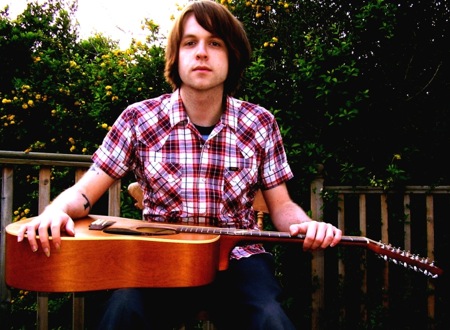
I have my man Josh at Turn It Up! to thank for my introduction to the music of British guitarist, pianist and composer James Blackshaw.  Who needs those fancy preference algorithms when you’ve got Josh and his dedicated cohort?  For here, in one handy musician, were so many of my favorite things:  Fine finger-picking guitar in the manner of John Fahey and Jack Rose, rich and detailed acoustic textures, complex rhythmic play, and the wonderful sense you get from some music of time suspended.  It was love at first listen.

If you want to hear what I heard, check out Blackshaw’s late-twenty-aughts masterpieces “The Glass Bead Game” and “All is Falling” (click on album titles for Spotify playlists) — just not while driving, lest you forget where you’re going.  Or go to the last three tracks of Blackshaw’s latest album, “Summoning Suns.”  The first, “Winter Flies,” is a brief taste of vintage Blackshaw: Lilting 6/8 rhythm, modal harmonies, that incredibly rich 12-string guitar.  Not having full knowledge of his current instrumentarium (I’m listening via a high-quality download with no album notes), I can’t say for sure how Blackshaw creates the resonant harp-like effect featured on the next track, “Holly”  — but my goodness, it’s beautiful, as are the track’s leisurely ruminations on tempos, moods and colors.  I dare you to not to be swept away.  And the finale, “Boo, Forever,” may strike you as an extended answer to Jorma Kaukonen’s “Embryonic Journey” from Jefferson Airplane’s “Surrealistic Pillow” album.  Yes, I know we’re going way back to the hash-infused heyday of psychedelia, but please bear with me.

But to to go back to the top of the album, after a bright instrumental prologue called “Averoigne,” the next five tracks give us something new:  Blackshaw’s voice.  And while I wouldn’t sing its praises (ahem) quite as loudly as the reviewer in Pitchfork, it’s not an unpleasant voice in the least, especially when blended into two lovely duets.  In “Confetti,” Blackshaw and Annie (daugher of Harry) Nilsson sing of cheap motels, poisonous spores and other cheery thoughts, all set to the most infectious, finger-popping tune you’ve heard this year.  I can’t tell you what Blackshaw and Kaoru Noda are singing about in “Towa Yo Nume” because it’s in Japanese, but again, the tune is irresistible.  These and the other songs fit nicely into the freak-folk genre pioneered by ’70’s Connecticut legend Garry Higgins on his cult album “Red Hash,” and maintained today the likes of Devendra Banhart and Joanna Newsome.  If  you like the scent of patchouli, you’ll love this music as much as I did.

Coming up: Music qua music

Johannes String Quartet (c) Lisa Marie Mazzucco

This afternoon at Smith College (short notice, I know), the Johannes String Quartet, along with John Dalley and Peter Wiley from the Guarneri Quartet will perform works by Esa-Pekka Salonen, Felix Mendelssohn and Johannes Brahms.  The concert, co-presented by Music In Deerfield, starts at 4:00, preceded by “Concert Conversations” at 3:00, and will take place at Sweeney Concert Hall, Sage Hall, Smith College, Northampton.  Tickets will be available at the door.  Click here for further information.

Here’s what I wrote for the program booklet: 

Elsewhere in today’s printed program, you’ll find information about the first work on today’s concert, Esa-Pekka Salonen’s “Homunculus.”  To say the least, Salonen has an unusual and colorful explanation for his music, one which would no doubt effect how you hear the work if you read the program note first.  But don’t start reading it yet.  I’ll explain why later.

So how about today’s other works, by Mendelssohn and Brahms?  How are they to be explained?

They can’t be, really.  Sure, we know a few salient fact about them, such as that Felix Mendelssohn composed his Quartet in F Minor as an homage to his sister Fanny Mendelssohn-Hensel (also a talented composer), to whom he was extraordinary close.  And that it was to be Mendelssohn’s last major work, his own life to end prematurely in the year of the quartet’s composition, 1847.  About the Brahms, other than its dates (1864-65), there’s even less to know.  So, to rephrase the question, how are these works to be heard?

As music, that’s how.  Among Romantic composers, Mendelssohn and Brahms were the foremost exponents of “absolute” music – must that tells no story, paints no picture, isn’t about anything.  While the other, more descriptive kind, usually called “program” music, is fun, “absolute” music represents the greatest tradition of classical instrumental composition.  Even “program” works (e.g., today’s Salonen) have to stand by themselves, not depending on their story, if they are to have any staying power.

Let me then suggest an alternate method of hearing “Homunculus,” one which of course you can select or reject as you prefer.  Try hearing it first, before reading Salonen’s program note.  Then, after it’s done, go ahead and read up.  You might find that this way, you’ll be more absorbed in the music and less distracted by the story.

P.S.  Here’s Salonen’s note on his work:

I wanted to compose a piece that would be very compact in form and duration, but still contain many different characters and textures. In other words, a little piece that behaves like a big piece.

I have long been fascinated (and amused) by the arcane spermists’ theory, who held the belief that the sperm was in fact a “little man” (homunculus) that was placed inside a woman for growth into a child. This seemed to them to neatly explain many of the mysteries of conception. It was later pointed out that if the sperm was a homunculus, identical in all but size to an adult, then the homunculus may have sperm of its own. This led to a reductio ad absurdum, with an endless chain of homunculi. This was not necessarily considered by spermists a fatal objection however, as it neatly explained how it was that “in Adam” all had sinned: the whole of humanity was already contained in his loins.

I decided to call my piece Homunculus despite the obvious weaknesses of the spermists’ thinking, as I find the idea of a perfect little man strangely moving.

Album du jour: Tobias Jesso, Jr.: “Goon”

packshot2

After worrying yesterday about the travails of classical music, today I’ve got some bright, shiny pop for you.  No wonder I find such pleasure in this music.

Here we have a young fellow from British Columbia with a knack for writing and singing songs that sound familiar the first time you hear them.  Part of that, to be sure, is to remind the listener very much of some other gentlemen with the same knack, such as the Messrs. McCartney, Simon, Nilsson and Joel.  But if Tobias Jesso, Jr. keeps doing stuff this good, he may someday deserve to be mentioned in the same sentence as the aforementioned giants of the field.

For now, Mr. Jesso sings about what he knows and feels, which in his case would be the normal preoccupations of youth.  Not that us middle-agers and seniors don’t also feel these things, but it’s nice to have a fresh perspective on them once in a while.  Do not, however, equate his ingenuousness with shallowness, at least after hearing the albums soulful centerpiece, “Hollywood.”  I’m not sure how the odd coda makes it a better song than if it had just come to a regular cadence,  but that’s one of the few things I question in a very likable album.  Fun for the whole family, from your pre-teen daughter to your grandmother — and for you too.


Listening to your audience

James B. Stewart’s New Yorker article “A Fight at the Opera,” is a must-read for anyone interested in the performing arts in America, as well as a further example of why the present and future state of our classical music and operatic institutions merits serious concern.

Stewart touches on many reasons for the Met’s precarious financial situation, including production costs, salaries and benefits, and increased need for donations to keep the whole operation afloat.  But I’d like to concentrate on one specific reason for concern:  the declining size of the audience.

And the numbers are stark.  Stewart:

Meanwhile, attendance had fallen from ninety-two per cent of capacity, in 2007-08, to seventy-nine per cent, in the 2012-13 season.

He later writes:

Gelb told the board in January that attendance was stabilizing this season at about seventy per cent of capacity. By mid-February, box-office revenue was running about two million dollars behind budget. Whatever the artistic and political merits of “The Death of Klinghoffer,” the controversial opera by John Adams about the murder by Palestinian terrorists of a Jewish passenger on a cruise ship, it sold seventy-four per cent of capacity—not bad for a contemporary opera but a dismal turnout for a new production. Some revivals of Gelb productions have fared worse. A performance of “Les Contes d’Hoffmann” sold just forty-six per cent. “Don Giovanni” and “La Traviata” sold seventy per cent and seventy-three per cent, respectively, which is low for such stalwarts of the repertoire. Attendance at pre-Gelb-era standbys has also faltered this season. The Met said that attendance at Taymor’s full-length “Magic Flute” averaged just sixty-one per cent; at Zeffirelli’s “La Bohème” it was seventy-eight per cent.

But between these passages, Stewart writes something that has me puzzled:

Still, by 2013, it was hard to blame the Met’s financial problems solely on the financial crisis. Audiences weren’t coming back, despite the new productions and the excitement that Gelb had brought.

To me, this is a classic case of confusing “despite” for “because of.”  And it made me realize something about Stewart’s article, something I find sadly typical of performing arts coverage:  While Stewart goes into detail on the operatic predilections of several Met board members, whose great wealth provides great access to Gelb’s ear, and while Stewart cites the critics’ opinion of Gelb’s productions, either by name (Alex Ross) or in the aggregate, nowhere, other than by counting attendance, does he deal seriously with the tastes of the audience.

But doesn’t the audience hold the key to the Met’s success and stability?  No audience, no opera.  You can earn all the critical huzzahs you wan’t.  If the house isn’t full enough, the show will eventually not go on.

People either go or don’t go the opera for a reason.  And when those who used to go no longer do, or go less frequently, they’re telling you something.  Maybe they’re bored, maybe they can’t afford as many tickets, maybe they’ve found something else they like better, maybe they’re dead.  But you don’t really know until you ask them.

As has another American classical organization with declining audience, the Pittsburgh Symphony Orchestra, as we can read in a Pittsburgh Post-Gazette article by reporter Elizabeth Bloom.  (Trigger warning:  The article involves market research and focus groups, the mere mention of which is known to give some classical musicians a rash.)

Note how the PSO is trying to understand not just its current audience, but also the kind of people who used to be in the classical audience but now aren’t.  Smart move.  Yeah, I know that what the focus group participants say about orchestra concerts (“stuffed-shirt, prim and proper,” “boring, relaxing, soothing and long”) drive some musicians and music lovers crazy.  I can already hear the accusations of “dumbing-down” and “pandering.”  But this is what real people really say.  If the future of your concert organization was at stake, wouldn’t you rather hear it than not hear it?

Now, what the orchestra does with this information remains to be seen, and will be interesting to track.  In the meantime, full credit to the Pittsburgh Symphony for listening to its audience.  It will be more successful for it.

Album du jour: Pearson Sound, “Pearson Sound”

CS2713054-02A-BIG

This album had me hooked right from the first track, a piece called “Asphalt Sparkle.”  In it, a bold melodic hook built of just three pitches (a fourth is occasionally sounded underneath as an implied drone) gets fragmented, varicolored, juggled and turned every-which-way, while the meter, reinforced by percussive thwacks, splashes, ratchets and booms, dares us to predict where the next downbeat will fall (thank you, Stravinsky).  After yesterday’s dreary album, what a treat!

And you know what?  That’s probably the most “melodic” (scare quotes used advisedly) track on the debut album by Pearson Sound, a project of British DJ and producer David Kennedy.  To paraphrase the lyrics of an old Jimmie Lunceford record, rhythm is his business, and business sure is swell.  Think of it as ambient minus the ambien, though I happen to find complex rhythmic interplay like this, even as crunchy and gritty as it is, to be oddly calming.  Your results may vary.  But do give it a try, and check back with me after you have.  Downloads, including high-quality FLAC, are available here.

Album du jour: Simone Dinnerstein, “Broadway-Lafayette”

Simone_Dinnerstein

Before we continue, would you do me a favor?  Listen to tracks 4, 5 and 6 of  the playlist below.  They contain a piano concerto called “The Circle and the Child,” composed by Philip Lasser, and performed by pianist Simone Dinnerstein, with Kristjan Järvi conducting the Leipzig Radio Symphony Orchestra, off of Simone’s new album “Broadway-Lafayette.”

OK?  Did did you listen?  Good.  Now please, someone, anyone, tell me:  What am I missing?  Have I totally lost my ability to hear music?  Am I out of my mind?  Or is that piece really as bad as it sounds?

I mean, I have boundless admiration for Simone Dinnerstein, whom I have both broadcast innumerable times and presented in recital.  Composer Lasser, whose music was previously unknown for me, does not lack for credentials — he’s on the faculty at Juilliard, for Pete’s sake.  And the album came out on Sony Classical, among the majorest of major labels.  Big artist, big composer, big label — and probably, big fee.

And what do I hear?  As shapeless and meandering a work as I’ve encountered in many a listen.  The imagination runs wild with analogies:  A soufflé that fails to rise, a mold that can’t hold its form, a car that spins its wheels in the mud (a friend and I came up with that one independently of each other).  It starts, stops, speeds up, slows down, gets louder, gets softer, and after twenty minutes, basically hasn’t budged.  I’ve given the piece hearing after hearing after hopeful, even desperate hearing, and I still can’t make any sense of it.  Can you?

I wouldn’t at all have minded the piece’s nostalgic, cinematic idiom, if the composer had really gone for it.  An updated equivalent to such ultra-romantic movie classics as Richard Addinsell’s “Warsaw Concerto” or Hubert Bath’s “Cornish Rhapsody” could have been delicious!

Instead, we get a cup of weak, lukewarm tea, bafflingly devoid of pizazz or bravura.  I don’t question Simone Dinnerstein’s devotion to this new work, which she commissioned and has played many times in concert.  But interpretively and virtuosically, she is severely underutilized here.  What a shame.  Even for an artist of her stature, major new commissions like this don’t happen every day.

And again, this is the big leagues.  If it were a minor composer and a minor performer, I wouldn’t say a peep.  I swear, if someone had told me that this was the first classical work of some newbie wannabee from another musical field, such as the works I reviewed here and here, I would have believed it. But from a Juillard prof?  Wow.  What gives?

Maybe the performers are partly at fault.  For even the two acknowledged masterworks on the program, Maurice Ravel’s Piano Concerto in G Major and George Gershwin’s “Rhapsody in Blue,” fail to come off very well.  The orchestra in particular sounds rather scruffy and scrappy, with more passages of poor ensemble and questionable intonation than should have been let go.  Neither do the Leipzigers’ recognizably Teutonic tone colors and leaden rhythms help in this Franco-American repertoire.  I can’t let Simone totally off the hook here either, as her playing in the Ravel and Gershwin lacks the poetry and tonal beauty that have made her one of my favorites.  And to spread the sweet green icing on this rain-sodden cake, the confined, unpleasantly forward recorded sound complements the album’s most salient qualities all too well.

(Added later on March 12, 2015:  So let’s not overlook producer Adam Abeshouse, a respected and awarded figure in his field who is ultimately responsible for what went wrong here.)

I take no pleasure in any of the above, and don’t mean to offend.  I’d much, much rather deliver good news than bad.  And I approached this album with the highest hopes.

But some things aren’t just bad, they’re wrong. Often, when I sample wines at a winery or an in-store tasting, I’m poured something that I don’t care for and would never buy, but which isn’t objectively terrible.  So I sip, swish, swallow, pour out and shut up.  Sometimes, however, I’m poured something from a big-time producer that should never have been foisted upon the public as ostensibly a beverage of pleasure.  And I say so.  Well, as with wine, so with music.

Paragraph du jour: Leon Botstein on philanthropy

The concluding paragraph of today’s New York Times article on the American Symphony Orchestra announcing a shorter season for 2015-16:

“The challenge facing classical music today is not a depletion of audience or potential audience, or the aging of the audience,” (ASO conductor Leon Botstein) wrote. “The real problem is that the very wealthy no longer consider it their civic responsibility to contribute to the traditions of the symphony orchestra. Their attentions have turned elsewhere.”

It strikes me that Mr. Botstein has this backwards.  The diminishing of classical philanthropy he blames for his orchestra’s problems has come about exactly because of the other causes he tries to wave away.  At a time when orchestras require increasingly more donations to stay afloat, those who have the means to make large donations are decreasingly interested in classical music.  The depletion and aging of the audience (which are really parts of the same thing) is not incidental to this.  It is the cause of it.  And classical philanthropy will keep going down until the audience size starts going up.

Past, present and future

ades Norman_colorKipJones_300dpi_Portrait1

(Left to right:  Thomas Adès, Andrew Norman, Kip Jones)

In music, as in the other arts, there is nothing more sic transit than gloria mundi.  History is replete with composers who were lionized in their day, only to have their reputations sink like a stone after their deaths.  Heard any nice Louis Spohr or Leo Sowerby lately?  I thought not.

Similar thing with musical styles.  We’ve just gone through pert near a century of being told (by a constantly shrinking cohort, I will admit) that atonality was the One True Path to the Future, and that any composer who failed to follow the Path was irrelevant.  Yes, I actually heard one of my UConn music profs, a gentle middle-aged man, say such a thing.  I won’t use his name, in part because unless you were at UConn with me, you’ve never heard of him or his music.  Turns out that the inevitable conquest of atonality was actually quite evitable.

Tricky thing, this future-predicting business.  Not that there aren’t those still willing to give it a try, the latest being Justin Davidson, one of my favorite classical critics — one of the few to out himself as a non-member of the Cult of Elli0tt Carter.  In a recent piece for the arts website Vulture, Davidson recommends two recent works as providing a “glimpse of the future of symphonic music.”

The works in question are British composer Thomas Adès‘s “Totentanz,” which you can check out in this video of its premiere performance…

…and Andrew Norman‘s “Play,” which you can hear here in a just-released recording by Gil Rose and the Boston Modern Orchestra Project:

Are they the “music of the future?”  I wouldn’t care to guess.  But the biggest reason I question Davidson’s judgment here is that, as I hear them, neither work really represents the music of the present.

This is especially true of Adès’s work, which sounds to me like a barely updated version of 20th-century German Expressionism, and early 20th-century at that.  In subject matter, harmonic language, performing style and overall mood, Adès, fine composer that he is, breaks no new ground, engages with no contemporary ideas or vernaculars, tells us nothing about being alive in the 21st century.  The ancient texts, in a language foreign to those in the concert hall, are sung by the kind of full-blown operatic voices that sound increasingly unnatural and off-putting to any listener not steeped in the classical tradition.  When contemporary classical  composition overall is moving toward a closer engagement with the here and now, how a work that shows much greater kinship with Alban Berg than with anything that anyone outside the minority classical music audience actually listens to nowadays could be a harbinger of the future is beyond me.

Next to Adès’s “Totentanz,” Andrew Norman’s very impressive “Play” sounds eminently up-to-date.  There’s a kind of action-movie, video-game ADD energy going on here that Adès lacks, as well as passages that demonstrate knowledge, if not full embrace, of minimalism, the most influential new classical style of the last generation.  Still, I would say that the gap between Norman’s muse and most of the music folks listen to ’round these parts today is pretty wide, wider than with lots of orchestral music I could think of.

Example?  Here’s a recent work composed for another outstanding Boston group, the chamber orchestra A Far Cry, by violinist-composer Kip Jones.  I wouldn’t dare compare Jones’s piece with Norman’s for complexity, nuance or scope.  But those are traditional classical music values not prioritized by almost any other music of our day.  On the other hand, Jones’s music has a beat, and contains melodies that sound like they were written in the 2010’s.

Another difference between Norman and Jones?  It strikes me that in “Play,” Andrew Norman made his bid for not just present success, but future success — a piece that would stand the test of time, like the great works of the past he clearly knows, loves and has learned from.  Whereas Kip Jones, in “Three Views of a Mountain,” wrote a piece that would fun for him and the orchestra to play and for audiences to hear in the short term, with little concern for permanence or posterity.  In my way of thinking, that makes Jones the more representative of the musical present, whereas Norman is the more concerned with the musical past and future.  I say, the past has already passed and the future can take care of itself.  Go for the present.

Paragraph du jour

Here’s the opening paragraph from Washington Post classical critic Anne Midgette’s review of Saturday’s DC recital by superstar pianist Lang Lang:

It’s fashionable, in certain circles, to complain that we live in a world that takes intelligence as a sign of elitism and scorns it accordingly. Yet many classical music lovers propagate this same divide by looking down their noses at anything that smacks of populism — including some of the most popular artists in the field.

You said it, Ms. Midgette!  Now, if I were to sneak just two more words into the paragraph, I would have written “Yet many classical music lovers and critics propagate the same divide…,” but that’s just me with my bad attitude about classical critics.  Well, if the critics keep writing such open-eyed and self-aware stuff as the above, my attitude may show signs of improvement.  Thanks!