The New York Times’ shocker!

13SERKIN-master675

No, the headline to this post doesn’t refer to the New York Times’ controversial firing of its executive editor Jill Abramson.  Neither do I mean the paper’s public editor, Margaret Sullivan, raking Book Review editor Pamela Paul over the coals for daring to publish a review that Ms. Sullivan disagreed with.  (I’m on the reviewer’s and Ms. Paul’s side, if you need to know.)

What I’m drawing your attention to from a few weeks back no doubt meant little to the typical Times reader.  But in its own small way, it’s something heartening and hopeful to those of us eager to have our beloved classical music move forward to a better, more audience-friendly place.

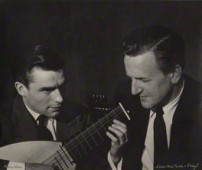
It came in Vivien Schweitzer’s review of a recital by pianist Peter Serkin at New York’s 92nd Street Y (photo above).  Mr. Serkin, one of America’s finest and most serious pianists, is by his own admission not a crowd-pleaser.  “I think that programs show integrity when there is no attempt to win anyone over at all,” he said in a 2011 conversation published on the 92Y Blog, and quoted by Ms. Schweitzer in her review.

True to that spirit, Mr, Serkin’s program under review consisted of one work by 16th/17th Dutch composer Jan Pieterszoon Sweelinck, three by veteran American Modernist* Charles Wuorinen, one piano rarity by Danish symphonist Carl Nielsen, and Beethoven’s “Les Adieux” (“Farewell”) Sonata.  Other than perhaps the fairly gentle Beethoven, there’s not a winner-overer in the bunch, with Wuorinen’s brand of gritty dissonance being an especially tough sell  — especially, apparently, to the half of the hall that declined to attend.

Normally, a close, long-time reader of Times’ classical reviews like me would have expected unreserved praise for Mr. Serkin’s thorny, audience-unfriendly programming.  From former critics Paul Griffiths and Edward Rothstein to current chief classical critic Anthony Tommasini, the Times’ critics have been staunch advocates of difficult, cerebral Modernism, despite/because of its lack of audience appeal.  And don’t think readers haven’t picked up on this.  After our last session, one of the attendees of a classical appreciation class I recently taught, someone whose musical knowledge would have to be described as very general, made this very observation, unprompted by me or anyone else within earshot.  Huh!

Anyhow, after turning her attention to Mr. Wuorinen’s works, Ms. Schweitzer shocked my world with the following paragraph:

It is often remarked that contemporary audiences have a greater appetite and appreciation for Modernist art than for Modernist music. But abstraction can be easier for the eye, than the ear, to absorb. A set of abstract shapes and colors can mesh into a mesmerizing visual whole, but the ear (or certainly my ear) struggles to process a series of notes and gestures that seem to have no connection to one another. Rigorous methods of composition can sometimes result in bafflingly disjointed sounds that resemble a nonsensical sentence.

All right, to you it may not be such a big deal.  Indeed, this point has been made many times over.  But to me, its appearance in a Times review is a sign that, however belatedly, perhaps the “paper of record” is finally getting with the times, if you’ll pardon the expression.  Not that Modernism has to be banished from the current concert scene.  But rather than persist in blaming the audience for not coming around to the music the critics prefer, even decades after the music’s heyday, it’s extremely refreshing to read a critic taking the audiences’ tastes seriously enough to ask why this might be, and to draw a conclusion that does not insult the audiences’ taste or intelligence.

As for Mr. Serkin, he may of course program as he likes, and adopt whatever relation to this audience he chooses.  If his audience responds to his refusal to win them over by their refusal to be won over, it’s not the audience’s fault.  How nice for a New York Times critic to say so.

*By “Modernism,” Ms. Schweitzer and others who use the term are not referring to current musical styles.  Rather, the term refers to a variety of loosely related musical styles of the 20th century, most of them extremely dissonant, composed by such leading figures as Pierre Boulez, Karlheinz Stockhausen, György Ligeti, Luciano Berio and Elliott Carter.  You might think of musical Modernism as the sound equivalent of Jackson Pollock, James Joyce, Ezra Pound, Samuel Becket, et al.
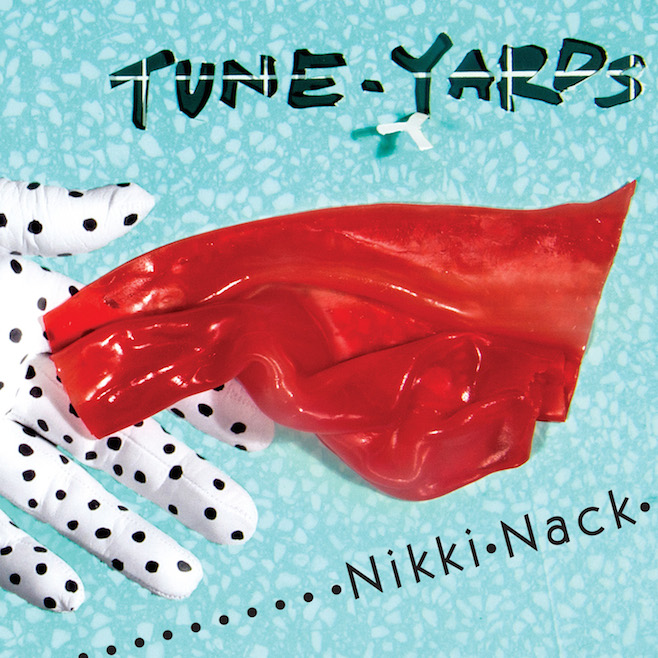
Album du jour: tUnE-yArDs, “Nikki Nack”

tune-yards-nikki-nack

Hey, I know what Smith College should do at commencement this Sunday!  Forget about bringing in some fancy big-name speaker, since it’s impossible to find one who is a) ideologically pure enough to pass muster and b) not a crashing bore.  It would be so much better if instead they had the group tUnE-yArDs, featuring Smith alumna Merrill Garbus, rock the crowd with a few choice tunes.  That would give ’em something they’ll long remember!

For those who haven’t had the pleasure, Ms. Garbus is a young (well, 35 is still young to me) woman of many voices, from coo to shout to growl to yodel, a multi-instrumentalist, an imaginative word-and-tunesmith, and an unstoppable, irresistible force of nature.  On her first two albums “BiRd-BrAiNs” and “WHOKILL,” her basic m.o. was to layer her voice and percussion via looping, while adding live vocal and instrumental textures and shredding on her electric ukulele.  Self-recorded on crude equipment, “BiRd-BrAiNs” was an out-of-left-field lo-fi delight.  The more studiophonic “WHOKILL,” which added two saxophones and the agile bass of Nate Brenner to the mix, elevated Merrill Garbus’s reputation to that of a leading creative figure of indie music.  What to do then, for a third album?

Mostly, you go light on the uke, rely less on loops and more on overdubs, synths and programming, invite in such guest performers as fiddler Sam Amidon, Haitian percussionist Daniel Brevil and the vocal ensemble Roomful of Teeth, and open the sound up very wide.  Compared to the first two, this is a produced album, with each song — make that each composition given its own instrumentarium and sonic mood.  Oh, the raw energy is still there in abundance, several of the pieces sounding like campfire shouts and jump rope chants writ large.  But there are new levels of nuance and blink-and-you’ll-miss-it detail that demand and repay multiple hearings.  I can’t think of a better album to demonstrate why this old classical coot has become so enamored of what these crazy kids are playing today.  If this music doesn’t lift you up, you may be beyond uplifting.

Now, I’m much more of a music than a lyrics guy, so I won’t go on to a critical analysis of Merrill Garbus’s poetics.  Let’s just leave it at this:  she’s saying something, and she says it with a much confidence as she shows in her music.  I couldn’t think of a better lesson for the new graduates of Smith College.

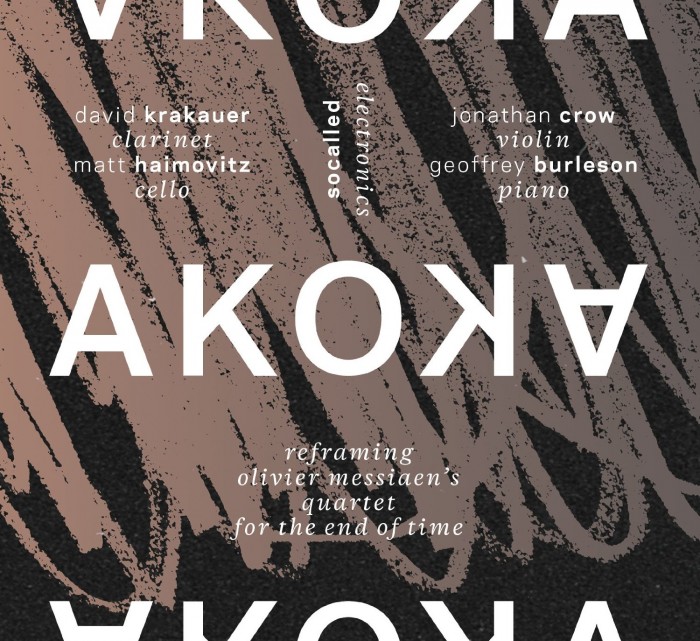
Album du jour: David Krakauer, Matt Haimovitz, et al., “Akoka”

812Mz9YudlL._SL1500_

On the cold and rainy night of January 15, 1941, in the unheated Barrack 27 of Stalag VIIIA in Görlitz, Germany, an audience of some 400 prisoners-of-war and guards listened in rapt silence as four musicians, performing on ramshackle instruments, gave the first performance of one of the great chamber works of the 20th century.  While it is doubtful that even the most devoted practitioner of historically-informed performance would want to recreate the premiere of Olivier Messiaen’s “Quatuor pour le fin du temps” (“Quartet for the End of Time”), this amazing backstory adds even further resonance to a work of stunning originality, power and spirit.  (For the full story, Rebecca Rischin’s For the End of Time: The Story of the Messiaen Quartet” is highly recommended.)

What’s that?  You’ve never heard Messiaen’s Quartet?  Well then, you’re in for an extraordinary musical experience, one which will grow with each hearing.  In eight movements, variously scored for one, two, three or all four instruments, Messiaen combines his favorite preoccupations, such as birdsong, rhythmic and melodic symmetry, synesthesia (e.g., musical rainbows) and fervent, sentimental Catholicism into perhaps this incredibly original composer’s most accessible large-scale work.  Not for nothing has the Quartet appealed over the years to audiences steeped in psychedelia, mysticism, minimalism, new age philosophy, eastern religion and just about every other alternative life- or musical style associated with adventurous youth.

On their splendid, just-released 2008 live concert recording (with violinist Jonathan Crow and pianist Geoffrey Burleson), clarinetist David Krakauer and cellist Matt Haimovitz have framed the Quartet with a works that pay tribute to the remarkable clarinetist of its premiere, an Algerian Jew named Henri Akoka.  As prologue, the four musicians collaborate on a mostly-improvised, electronically-enhanced piece (credited to Krakauer) called “Akoka,” transforming elements of the Messiaen into a Klezmer-ish lament and dance filled with clarinet smears, cello scrapes (much like those Matt Haimovitz employed in his celebrated version of Jimi Hendrix’s “Anthem”), scratchy violin off-beats and strummed piano strings.

For the epilogue, Canadian producer Socalled (Josh Dolgin) “merges live samples of the musicians with old radio broadcasts, hiphop, cantorial singing and markers of time…” into a piece called “MEANWHILE…”  Of all the album’s ten tracks, this will probably age least well, especially its rapped passages.  For the present, it’s a stimulating modern commentary on a great musical work.

But it’s the performance of the Quartet that commends and rewards most of our attention here.  Not that there aren’t excellent alternative versions in the current discography, but this one can take its place with the best of them for both individual and ensemble excellence.  To cite just a few examples:  The quiet central passage of the 2nd movement, “Vocalise, for the Angel Who Announces the End of Time” has rarely been as mesmerizing.  David Krakauer’s superb rendition of the 3rd movement clarinet solo, “Abyss of the Birds,” is filled with personality, subtly reminding us that for all its mellow mellifluousness, the clarinet was also the instrument par excellence of the red light district, the shtetl and the Roma encampment.  And Matt Haimovitz’s modulation of both tone color and vibrato in the sublime 5th movement duo, “Praise to the Eternity of Jesus” are wondrous to hear — artistry of the highest order.  

Messiaen’s Quartet for the End of Time is best experienced live — what great work isn’t?  In the meantime, and for keeps, this fine, imaginative CD is highly recommended, and will fit right into your shelf next to your Mahler, your Moby, your Moondog and your Mozart.  At least that’s where it is on my shelf.

Must we mock the middlebrow?

250244

Kenny G.  Josh Groban.  André Rieu.  John Tesh.  Yanni.

Are you done rolling your eyes yet?

We’ve all done it — tisked, made gagging noises, and yes, rolled our eyes at the merest mention of these and other avatars of the musical middlebrow, mainstays of PBS fundraising specials and arena-filling “crossover” stars.  What makes us react in such a knee-jerk fashion, and with such opprobrium?  I mean, no one’s forcing us to listen to these performers.

It strikes me that our reactions are a kind of defense mechanism.  We have aesthetic reputations to uphold.  Therefore, we must join in the ritual disparaging of such musical bêtes noires, lest we be accused of plebeian tastes.  Sure, it’s acceptable, downright hip even, to wallow in absolute trash once in a while.  But the music of the middle class?  Never!  And as so often happens when people of like opinions congregate, a competition develops among musical sophisticates to see who can make the snidest, snarkiest, most extreme comment about the offending artist.  You know, like what happens in the Pioneer Valley when the name of a conservative political icon is mentioned.  Ronald Reagan?  Gag!

Well, it’s one thing for us in the lay community to engage in such minor and harmless snobberies in the privacy of our own homes.  It’s another when the High Priests of Musical Opinion — New York Times critics — descend to our level.  That’s what happened in a piece is Saturday’s paper in which pop critic Jon Caramanica and classical critic Zachary Woolfe took turns dissing the music of Lindsey Stirling (pictured above), an artist who was, I must confess, previously unknown to me.

Apparently, Ms. Stirling has become quite the hit on YouTube for her videos showcasing her combined talents as violinist, dancer and composer.  Here’s one for you:

Did it blow you away?  Me neither.  But did you feel as if your delicate and high-minded artistic sensibilities were under siege?  I didn’t; indeed, I thought it was absolutely inoffensive fun, kind of like the outlandish Bollywood videos where the stars are suddenly, and for no conceivable reason, transported from the plains of Punjab to the summit of an Alp.  If I never see another Lindsey Stirling video, I’ll get along just fine, but I didn’t mind seeing this one at all.

And for Pete’s sake, it would never occur to me to grade her violin playing or dance moves from the highest critical perspective.  Nothing, it strikes me, could be further from the point.  I’m not expecting Hilary Hahn here, and not the least bit offended that Ms. Stirling’s playing is fairly rudimentary.  Same goes with the dance, though that’s not my area of expertise.  Some combination of elements, whatever they may be, have made Lindsey Stirling appeal to an audience of millions.  I may not be among them, but I have to hand it to her — she’s got what they want.

But oh, the critical condescension of Mssrs. Caramanica and Woolfe!  A few money quotes: “She seems to be a competent though hardly dazzling player.”  “Is this study music for nerdy teenage girls?”  “She deploys the sort of moves that would leave our dance critic colleagues uneasy and unimpressed.” “She evokes the authenticity that old-fashioned classical music embodies for many without demanding much of her audience.” “And Stirling’s strengths don’t include her melodies, so, no, I don’t think the opera singers of 2035 will want much to do with her.”

I suppose each of these quotes is defensible, if you want to judge Stirling by such standards.  I think that doing so is rather silly, like having an art history professor critique the late Bob Ross’s “The Magic of Oil Painting.”  Much more useful for me would be to view her work through the eyes of her core audience.  What draws them do her?  And then, if you want to bring classical music and classy pop into the equation, what could each of these styles pick up from Stirling’s appeal?

Because the audience for Lindsey Stirling almost certainly contains a lot of people who, once upon a time, would have listened to classical music, but currently don’t.  Putting down these peoples’ current favorite artist — and by extension, putting down these peoples’ supposedly inferior taste — is no way to win them to your side.  It might make you feel good to distance yourself from music that’s beneath you, but in the long run, it hinders, rather than helps, the cause of music.

Album du jour: Olga Bell’s “Край” (“Krai”)

bellHex_510a3623580494_2

Now here’s something you don’t come across every day:  a cycle of nine original and traditional Russian texts, arrayed as a west-to-east travelogue through obscure regions of the sprawling Russian nation, set to music for an ensemble of cello, electric guitar, bass, percussion, electronics and a six-part vocal ensemble — actually, one voice six times over, and covering the spectrum from high soprano to (with electronic assistance) deep bass.  And oh by the way, the singer is also the composer, a multi-talented musician born in Russia, raised in Alaska, educated at the New England Conservatory and currently based in (where else?) Brooklyn.

That, in a nutshell, is Olga Bell‘s “Край” (“Krai”), its title translated in the booklet as “edge, brink, border, frontier, hinterland.”  It’s music from the edge, all right, kind of a cross of Björk and “Le Mystère des Voix Bulgares,” with perhaps a nod toward Sufjan Stevens’s odd-metered chamber pop and the female vocal backing of the intriguing Brooklyn-based group Dirty Projectors, of which Ms. Bell is currently keyboardist and vocalist.

But heck, it’s no fun reading descriptions of such wild music if you can’t hear it.  So check it out or buy a copy (high-quality download, CD or vinyl), and get to know another of the unique young female musicians who may, if you’ll permit them, convince even the most classically-oriented among you that much, perhaps most, of today’s most creative new sounds are coming not from classical, but from the edges, brinks, borders, frontiers and hinterlands of music.

Coming up: A journey into the piano’s past

Strei1846_001

Did you know, music lovers, that one of the country’s and perhaps world’s finest collections of historic pianos lives in an old town building in the small central Massachusetts hamlet of Ashburnham?  That’s where you’ll find the Frederick Historic Piano Collection  — and where you’ll also frequently find the eponymous Mike and Pat Frederick giving a tour, complete with hands-on demonstrations, of over 130 years of the piano-makers’ art.  Check out a 2001 New York Times profile of the Fredericks and their collection.

You might not know your Erard from your Pleyel, and couldn’t tell the difference between a Streicher and a Blüthner. But should you ever be fortunate (or generous) enough to accompany the Fredericks on their journey through their collection, you’ll never hear piano music the same way again.  You can take on on-line tour here.

But there’s another way to hear these wonderful old instruments:  one at a time, on the concerts the Fredericks put on each spring and fall at the nearby Ashburnham Community Church.  That’s when a fine roster of pianists and other musicians, some travelling considerable distance just to make music with these beautiful instruments, perform diverse and delightful programs designed to complement the pianos chosen for the occasion.  The wife and I have attended over a dozen such concerts, and have come away each time with an increased appreciation for the symbiosis of instrument and repertoire.  And a few count as some of my favorite piano recitals ever.

Unfortunately, we won’t be able to attend the next concert of the Historical Piano Concerts spring season this Sunday, when the excellent Russian-American pianist Constantine Finehouse will play a mouth-watering program of late Chopin and Schumann’s glorious Fantasy on a 1846 Streicher (pictured above).  But that’s our tough luck, not yours.

So, let me recommend in the most positive terms a trip out Route 2 and points north some Sunday through June 1.  On a nice day, arrive early and take a stroll on the grounds of the nearby Cushing Academy, America’s oldest co-educational boarding school.  Then, get a good seat, adjust your ears and sensibilities to an earlier time, and enjoy some wonderful music played on instruments the composer had in mind — and in some cases, might himself have actually played.  You’ll be very glad you did.


Should classical musicians get political?

lmd

Greg Sandow’s excellent blog just reposted a very worthwhile piece from Polyphonic.org by cellist/blogger/composer Peter Sachon (pictured above).  In it, Sachon calls for orchestras do more to attract a crucial but neglected segment of the population:  millennials.  Why and how?  Here are the first and last final paragraphs:

Orchestras need to offer compelling reasons for millennials to make live symphonic music a part of their lives. After all, millennials are the largest generation in human history, and at nearly 90 million people they will very soon make up the vast majority of our orchestras’ stakeholders, constituents, audience, staff members and supporters — and instrumentalists. By 2017, they will surpass the buying power of the baby boomer generation. There is simply no generation in the next forty years that will have the size and potential purchasing power to influence American orchestras more than millennials. While orchestras aren’t the only institutions that have abandoned the young, they can still be among the first to reclaim them — and in so doing they can begin to reclaim the position of live orchestral music in American culture…

The genius of the millennial’s viewpoint is that it can help release orchestras from the too-heavy bonds of history. This big-tent outlook not only allows orchestras to program and present music from across a spectrum of genres and forms, it gives orchestras a new artistic baseline so that they may grow into the modern era. When it’s just as valid, artistically, to find genius in a videogame score as it is in a commissioned piece, then orchestras will find themselves in a position to use both artistic standards and the market to fulfill their mission to bring symphonic music to as many people as possible.

“Videogames,” you might ask with concern?  Well…why not?  Anyhow, read the whole fairly brief piece.  I think Sachon is on to something very important here, as he pleads for orchestras and other classical musicians to rethink their long-standing programming paradigms  — their “genre silos,” in his formulation — and learn to see and hear their programming through the sensibilities of their prospective young audiences.

But one earlier section of Sachon’s piece has had me thinking the last few days.  He starts with this…

These millennials have very different expectations for nonprofits than baby boomers. Their expectations that nonprofits be socially conscious institutions goes beyond what is traditionally expected, especially from performing arts organizations. Being able to trust a nonprofit organization and its mission is very important to compelling millennials to attend and donate. One telling statistic is that nine out of ten millennials would stop giving to an organization that had lost their trust.

…and then goes on to chide orchestras for not taking stands on such human rights issues as the imprisonment of the Russian punk group Pussy Riot, Russia’s anti-gay legislation, and recent government crackdowns on protesters in Venezuela — the kinds of issues many prominent pop musicians have addressed, but about which classical musicians (with important exceptions, to be sure) have avoided.

Well, it’s no great credit to me that I happen to agree with the stances Sachon urges on these particular cases.  But I would offer a couple of caveats.

First, most prominent conductors are not free agents, but representatives (and employees) of large institutions, i.e., orchestras.  What they say can reasonably be taken as representing the institutional position of their orchestra, which may not, for an assortment of reasons, want to take a position on the matter at hand.  A pop musician like Björk, for instance, can speak for herself and herself alone.  And, to cite one prominent example, a solo classical musician like pianist Gabriela Montero can speak out strongly against the policies of Venezuelan president Nicolás Maduro, and risk backlash against just herself.  By contrast, conductor Gustavo Dudamel, who was roundly criticized (including by me, I have to admit) for not denouncing the recent political violence in his native Venezuela while conducting there recently may feel constrained by his position as conductor — and public face — of the Los Angeles Philharmonic.  That’s not to excuse his silence in the wake of brutality, but to highlight the fraught nature of his position.

Second, it’s one thing to ask classical musicians to speak out on issues where the good and evil seem fairly well-defined, like those Sachon cites.  But how about the more contentious issues of the day?  Should classical musicians take stands on Supreme Court cases, or pending environmental legislation?  They of course should be free to do so — but only if they respect the fact that a substantial portion of their paying audience may have a different opinion on the matter.

Again, that doesn’t have to be a problem, if the musician speaks out respectfully and intelligently off-stage, then keeps the politics out of the performance.  But being human, I will admit to great reluctance to attend movies featuring such politically outspoken — and in my opinion, shameful — actors as Sean Penn and Emma Thompson.   Frankly, they make me sick, and I refuse to bask in the glow of their projected image.  Am I wrong to engage in my private boycott — or am I exercising the same free will they do when they speak out?

And I can think of times when during folk and pop performances, musicians have harshly and profanely denounced political views I happened to hold.  Am I supposed to just sit there and think “thanks for sharing?”  Then there was the time during the recent “Encores” revival of Stephen Sondheim’s “Merrily We Roll Along” when the actor playing the TV interviewer broke script to make a political statement, earning herself the cheaply-bought applause of much of the audience — and one lone, loud “boo” from me.

Was I rude to have responded that way?  Not in my book.  In my view, there’s no such thing as a no-fault opinion.  If you speak out hoping to be cheered, you have to expect to be jeered as well.  So, whether you’re a classical musician, or any other public figure, remember that any political or other extra-curricular speech, while free, can also be divisive, and ask yourself whether your public voicing of opinions is worth alienating a segment of your otherwise admiring audience.

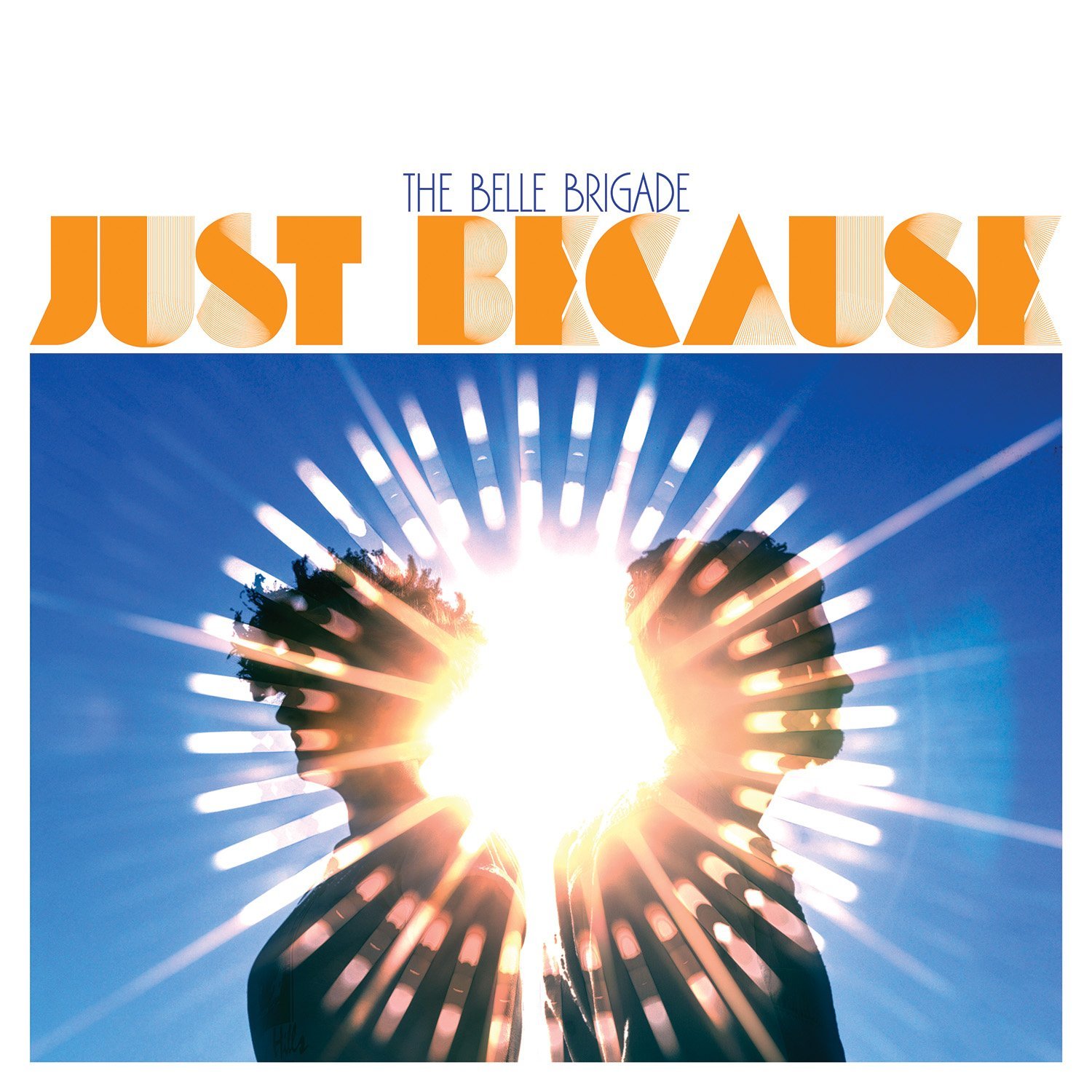
Album du jour: The Belle Brigade’s “Just Because”


81YzKoB6WqL._SL1500_

The first time you hear the country twang of Barbara and Ethan Gruska, the siblings who make up The Belle Brigade, you might attempt to guess where they’re from.  Is it Chapel Hill, or Athens, or some other redoubt of southern hipster culture?

Nope.  The Gruska sibs are Angelenos, the children of movie and TV composer Jay Gruska, and the grandchildren of film music giant John Williams.  You got a problem with that?  If so, and if you were to apply the same standard of stylistic authenticity to all music, you’d have the world’s smallest record collection.

But one thing’s for sure:  Wherever they got the way they sing, they got it at the same place.  Like such renowned sibling groups as the Boswells, the Louvins and the Everlys (to whom the Belle Brigade are oft likened), the Gruskas effortlessly match pitch, match vowels (something choral directors spend much time and much hair pigmentation trying to perfect), and, remarkably for brother and sister, sing in just about the same range, thanks to Ethan’s naturally high tenor.  In short, the Gruska sibs do harmony like they do breathing.

And on “Just Because,” the Belle Brigade’s follow-up to their self-titled 2011 recording debut, what they harmonize on are country-tinged folk-rock songs that range from good to very good to potentially classic.  Not only have the Belle Brigade avoided the dreaded sophomore slump (a baseball fan will explain the term to you), they’ve stepped up the profile and individuality of their repertoire from first album to second, to the point that all but maybe one or two of their new songs are eminently cover-worthy.  Sure, you still hear a little Paul Simon (an avowed inspiration) here, a little Fleetwood Mac there, and even one selection, the haunting “Metropolis,” that sounds like a long-lost item from the Elliott Smith songbook.  Well, if it’s 100% US Grade A originality you’re looking for, see my comment above about the world’s smallest record collection.  From here on out, the Belle Brigade are themselves a reference point for excellent songwriting.

A word of praise is also due for the album’s production, some of the smartest and most musical lo-fi I’ve heard in some time.  I love the way each song is given a unique color, and how carefully and creatively the voices and instruments are placed on the aural landscape.  Here’s a first-rate album in every way, from some very, very talented performers.  Heck, there might even be room for it in the world’s smallest record collection.

Coming up: Guitars for the Glory of God

Duo_Orfeo-640

Some changes in classical music during my almost fifty years as a devoted listener and chronicler are so striking that even I couldn’t fail to notice them.  High on that list would be the rise of the classical guitar, from what was once an interesting fringe populated by a few capable performers (Segovia, Bream, Williams, et al.), to what is now a bustling center of diverse creativity and high-quality production.  Put another way, there are more guitarists who play with more skill and more worthwhile guitar repertoire from all over the world than could have been imagined a generation ago.

A taste for the classical guitar seems to be a generational thing, if my experience is any guide.  During my radio years, a slow but steady drip of anti-guitar complaints, almost always from well-aged listeners, never let me forget that there was a time, not all that long ago, that the guitar wasn’t taken seriously as a classical instrument.  So what changed?  Basically, popular music changed, and elevated the guitar to the central position of American musical culture formerly occupied by the piano.  So, more guitars were in the hands of more guitarists, some small but significant percentage of whom gravitated to classical music.

And many of those classical guitarists never broke away from their popular roots.  Hence, we have a modern classical guitar repertoire that remains much closer to the folk and popular vernacular, wherever that vernacular my be from, than is the norm for classical composition.  We also have myriad guitarists tinkering with the instrument itself, each coming up with his/her own unique design.  By now, Valley music fans are no doubt familiar with Michael Nix and his banjo-guitar hybrid, the banjar, and with Peter Blanchette and his self-designed 11-string “Rock Steady” archguitar.

Well, as if we didn’t have enough weird classical “guitars” around here, now we have a pair of classical guitar-slingers who show up at their gigs with an instrumentarium that includes vintage Fender and Gibson electrics, with well-worn old tube amps to match.  Yikes!  An aural onslaught?

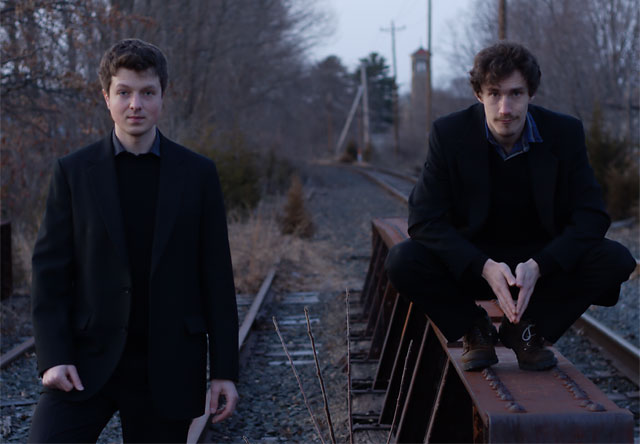
Au contraire, mes amis.  The members of Duo Orfeo — Jamie Balmer (above left) and Joseph Ricker (right) — plug in to chill out.  As we have known since Bing Crosby’s microphone replaced Al Jolson’s megaphone some 80 years ago, amplification permits not just greater volume, but also greater intimacy.  One doesn’t have to shout all the time when, with an electronic boost, one can whisper.  In this spirit, Jamie and Joe specialize in the quieter side of the classical repertoire, crafting delicate arrangements of masterworks drawn from many centuries of composition  to “(bring) to life a world of sound that is intimate, charming, subtle and haunting.”

Next up for Duo Orfeo is a concert called “Soli Deo Gloria” (“To the Glory of God Alone,” an inscription on many of J.S. Bach’s manuscripts) this Sunday afternoon at Hartford’s Trinity Episcopal Church.  It’s not your basic program of guitar favorites, including as it does arrangements of works by Guillaume de Machaut, William Byrd, J.S Bach, Gabriel Fauré, Frédéric Chopin, and Arvo Pärt,  along with new things composed for them by Thomas Shuttenhelm and Joe Ricker.  Having heard Duo Orfeo on a couple of occasions, I can assure you that their music is indeed “intimate, charming, subtle and haunting” — to which I may add mesmerizing, musically rewarding, and definitely worth 90 minutes of your Sunday afternoon.