Album du jour: DJ Koze, “DJ-Kicks 50th Anniversary”

artworks-000118470949-epzkes-t500x500

Back in my radio hosting days at NEPR (you haven’t forgotten already, have you?), I blogged a blog titled “Arrangements, transcriptions and covers.” Neither totally the same nor totally different, these three terms refer to various ways one piece of music can be transformed into another that bears some recognizable relationship to the first. Do give it a quick read before proceeding, taking care not to miss the video at the end by the late great Leonard Nimoy.

Now we come to another method of musical transformation, one that has characterized much of the dance music of the last generation: the remix, or simply mix. To quote (i.e, copy & paste) from that endless source of knowledge and wisdom, Wikipedia, a remix “is a piece of media which has been altered from its original state by adding, removing, and/or changing pieces of the item. A song, piece of artwork, book, video, or photograph can all be remixes. The only characteristic of a remix is that it appropriates and changes other materials to create something new.”

How is that different from the techniques I blogged about earlier? Here’s one way to think about it: While transcriptions, arrangements and covers start with a piece of music, or even just a melody, in its abstract state, not necessarily in any particular performance, and create new scores (whether notated or not) for performance, a remix starts with an audio realization of the original music, which it then transforms through electronic manipulation. In other words, a remix remixes sounds, not notes.

Still unclear? Well then, check out the music Stefan Kozalla, the veteran German music producer better known as DJ Koze. In his latest CD, the 50th (!) in a long-running series called “DJ-Kicks,” Kozalla and a couple of guest mixmasters take nineteen original tracks by as many different artists, then variously strip away vocals or instruments (after obtaining the original master tracks), add new sounds, combine two tracks into one, create interesting segues (much appreciated by this old radio guy) and sometimes even leave the original music alone. It’s a more intentional version of what dance club DJs (which DJ Koze once was) do spontaneously in live action. And it also reminds me of the cassettes of favorite tracks I used to make for friends, complete with interspersed commentary and tricky edits. (Pardon me if you already know this and a lot more about remixes;  I suspect that some of my readers are just catching up.)

Oh, and I almost forgot — the album sounds really cool, and is highly recommended for light summer listening. Below, you’ll find one playlist containing the complete “DJ-Kicks 50th Anniversary,” and another containing every original un-remixed track I could find. I even stuck videos of a couple I couldn’t find at the bottom. Yeah, this is the kind of thing nerdy retirees do to fill their time. And a hearty “live long and prosper” to the first person to notice what this new album has in common with my old NEPR blog post on transcriptions, etc.
Article du jour: Marc Myers on Ornette Coleman

From critic Marc Myers‘s June 15 appreciation of the late avant-garde jazz musician Ornette Coleman in the Wall Street Journal:

Mr. Coleman’s enduring relevance and legacy are all the more remarkable in a culture that tends to recognize and reward musicians who appeal to the mass market.

Mr. Myers is spot on in his description of our culture — our human culture. That we humans recognize and reward the musicians who appeal to the most people should be obvious to the point of tautology. Myers may refer in Adorno-esque fashion to those who like such popular music as the “mass market,” but really, they’re just folks like you ‘n’ me, listening to what they like and not to what they don’t like.

And what’s not to like about Ornette Coleman? Nothing, says Marc Myers, according to whom Coleman…

…reach(ed) a position of eminence on par with jazz innovators like (Charlie) Parker, Dizzy Gillespie, Sonny Rollins, Miles Davis and John Coltrane.

Which would be like saying that John Cage reached a position of eminence on par with classical innovators like Debussy, Stravinsky, Schoenberg and Bartók. In other words: He. Did. Not.

True, Coleman’s “free” style created quite a ruckus in the jazz scene of the late ‘fifties and early ‘sixties, and left an impression on a significant number of subsequent musicians. But looking back, Coleman’s period of greatest notoriety (and by far best music) seems just a moment in time, followed by decades of intermittently interesting but more often negligible music, much of which, I have to admit, provides me with little or no pleasure. Like Myers, I went back to Coleman’s discography to update my opinion. It remains decidedly mixed.

I could go on citing the myriad straw men and exaggerations of Myers’s article, from the “mainstream jazz fans, who tend to be most comfortable with swing and bebop interpretations of songs they already know” to the “jazz fans (who) may be surprised to find themselves actually enjoying Mr. Coleman’s music, which does still require us to think while we listen.” You see, in Marc Myers’s view, not to like Ornette Coleman is testament to one’s lack of sophistication, adventurousness and even intelligence. Couldn’t it be as simple as lots of people thinking that Coleman’s music sounds bad? Isn’t that a perfectly reasonable reaction to, say, the vaunted “Skies of America?” It’s certainly my reaction, and I’d like to think I’m a fairly smart and open-minded listener.

If Marc Myers wants to praise Ornette Coleman, fine. Coleman was a dedicated artist and American original. It undermines Myers’s cause, however, when he places Coleman on par with artists who tower over him, and when he insults those who have a lower estimation of Coleman. You have a right to like and not like whatever music you choose, and no one has a right to tell you your choices are wrong.

Listen for yourself:

That Tingling Sensation

Cocoanuts-Harpo-Solo

Soft speaking and whispering. The crackle of a wood fire. Fingers tapping on a keyboard. The crinkle of turning pages. Bob Ross cooing about happy little trees, accompanied by the ch-ch-ch of his brush on a canvas.

Do any of these sounds, or even thinking about these sounds, give you a tingle across your scalp, down your neck and along your extremities? If yes, then you, as am I, are susceptible to ASMR.

That’s Autonomous Sensory Meridian Response, for those who haven’t discovered the burgeoning subculture of ASMR audio, video, radio, and who knows what else. I’ve felt ASMR all my life without knowing it was, as they say, “a thing,” or that others reacted to the same triggers as I did. I came across the ASMR subculture only a few weeks ago, while seeking further information on “Lonely at the Top,” a track off of Holly Herndon‘s recent “Platform” album.

As you can hear by clicking on its title, “Lonely at the Top” presents the soft, intimate voice of a woman welcoming a client to an appointment for a massage, and for whatever else your perfervid imagination may picture, while in the background, crinkling paper, fingers tapping on a keyboard, pouring water and other quotidian sounds add to the atmosphere. Turns out that the voice belongs to one Claire Tolan, an ASMR sound artist and radio host, and that this track was meant, in a small way, to do for ASMR what Mozart’s “The Magic Flute” did for Freemasonry: introduce a hidden subculture to outsiders.

But don’t get the wrong idea about ASMR from “Lonely at the Top.” ASMR is not meant as a turn-on. Indeed, most of us tingle junkies go for a fix not when we need arousal, but when we need to be calmed down. To erase the cares of the day and aid relaxation and sleep, there’s nothing better.

OK then, “Lonely at the Top” aside, what other musical sounds trigger my tingles? Most of my musical triggers involve the intimate contact of natural elements: Fingers on strings. Soft mallets on wood or metal. The brushwork jazz drummers perform when they “lay a carpet” behind a slow ballad. The celeste on Chet Baker’s early vocal recordings. Harpo’s solos in the Marx Brothers movies. A master of the balafon. Guitarist Joe Pass, up close and personal.

Or they could be warm, intimate vocals, the kind that feel as if they were whispered right into your ear: A great mezzo singing “Premiers transports” in Hector Berlioz’s “Roméo et Juliette.” The Fleetwoods a cappella. Something off Grouper’s last album. Just compiling this list makes me all tingly.

Why do these sounds trigger my ASMR and not others? According to the limited research on the subject, one not fully embraced by the scientific or medical communities, all of us in the ASMR camp have our unique trigger set, though some stimuli are fairly consistent. Many of mine are typical. But one thing that many of my triggers have in common is the audible and/or visual sensation of a craftsperson focusing intensely on his/her work.

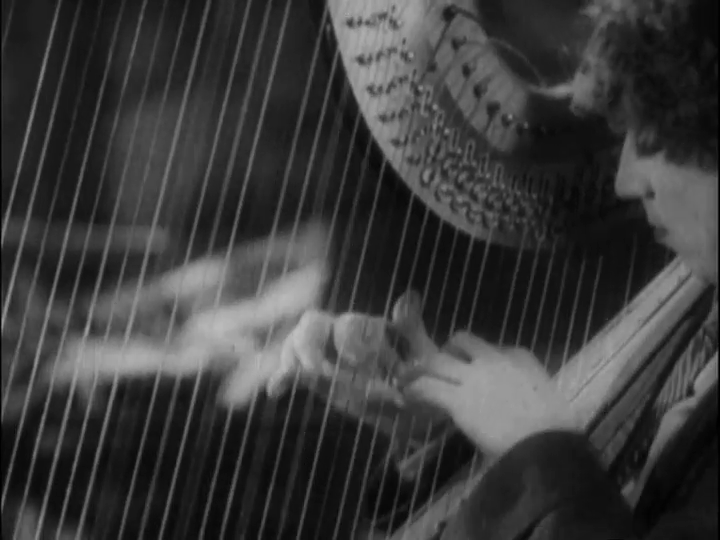
Consider, from the above lists, Harpo Marx’s harp solos in the Marx Brothers comedies. Vestiges from the Marx’s vaudeville routines, the harp solos have struck some viewers and (especially) critics as hokey intrusions into the films’ anarchic scenarios. And Harpo’s technique, while deft, was distinctly homemade. But these scenes always get to me, in no small part because of the look of rapt concentration that emanates from the great clown’s face as he gently strokes his strings. The effect is magical.

Perhaps this feeling goes some way to describing my lifelong “musicophilia,” to borrow Oliver Saks’s term. For both beauty of sound and focused mastery, what can beat music? If you have some favorite musical AMSR triggers, please share. We’re always on the lookout for new ones.

(Illustration: Harpo Marx in the 1929 film “The Cocoanuts”)

Album du jour: Johanna Warren, “nūmūn”

Johanna Warren nūmūn

Stunning. Johanna Warren‘s soprano voice rings clear and true, whether soloing or blending with itself to create gorgeous harmonies. Her sinuous melodies, odd meters, moonstruck lyrics and love of drones, pedals and grounds combine for a timeless and exotic quality; I’m transported and mesmerized each time I listen. Precious? Yes, in the best sense of the word. Here’s a legitimate heiress to such foremothers of goddess-folk as Linda Perhacs and Vashti Bunyan, both of whom came out with valedictory albums in 2014. Please listen.

Playlist du jour: Uncover Versions

linda

(Illustration: Solomon Linda and the Evening Birds, the artists on the first track.)

Here’s a Spotify playlist I put together for my own amusement, but which you might enjoy as well. It contains hit songs of the golden age of pop (i.e., when I was a kid, of course), the ‘sixties and early ‘seventies, in their original recordings and/or in recordings by their composers. Some of these “uncovers” are well-known, others far less so. There are a couple of terrific recordings on this theme that aren’t on Spotify, so I’ve included YouTube videos below. Have fun!

Paragraph du jour: Alex Ross on conductors

From a few weeks ago (things move slowly in the classicalsphere), Alex Ross in The New Yorker:

Not the least of the challenges that classical music faces is the increasingly unworkable celebrity-maestro model—a twentieth-century mutation, stemming from a disproportionate emphasis on the music of prior eras. It is fundamentally irrational for musicians to play the same passel of pieces over and over. Conductors serve to generate the illusion of novelty: as Theodor W. Adorno wrote, in his “Introduction to the Sociology of Music,” the maestro “acts as if he were creating the work here and now.” That top-tier conductors are almost always men is less an indication of institutional misogyny—though that certainly exists—than an inevitable consequence of the play-acting ritual: because the canonical composers are entirely male, so are their stand-ins. The modern orchestra concert is not entirely unrelated to the spectacle of a Civil War reënactment.

Where’s the classical?

mlcm

(Illustration from the “Classical Music is Boring” website. Yes, there is such a thing, and it’s a hoot.)

Two of the least interesting topics on any blog are the blog and the blogger. So please pardon me as I write about both this time. I’ll return to my normal outward-looking blog next time.

Most of my readers, I suspect, know me best as a classical music presenter, both on the radio and in concert. To paraphrase the old Saturday Night Live sketch, classical music been berry, berry good to me. Then why are so many of the reviewed albums on this blog of the non-classical persuasion? Why all the pop, rock, indie, techno, etc., but so little classical?

It’s because at this present moment — and it could change — pop and its myriad sub-  and sub-sub-genres are where I find the most creativity, excitement and entertainment of any musical genre. They’re abuzz with talent, filled with surprises. I never know when I’m going to discover something new, from out of the blue, that knocks me out and becomes part of my life’s soundtrack.

To be sure, I can get the same buzz from other genres, including classical, especially classical of the freshly-composed persuasion. But at present, perhaps as a reaction to having wallowed in it for the better part of four decades, the vast majority of what parades around under the classical banner bores me. With many precious exceptions, I no longer feel excitement for the thousandth iteration of anything from the incredibly tiny slice of the repertoire included in the classical canon. Since I can’t feel the excitement, I won’t feign it, especially since I no longer draw a paycheck from presenting classical music. My blog is my hobby, and I can write about whatever pleases me. How liberating!

Does that make my radio career a sham? I don’t think so, because I never stopped getting a rush from presenting classical music to those who depended on it. But toward the end, I was troubled by how far my private enthusiasms and professional enthusiasms had diverged. And yes, I did increasingly have to feign excitement for the latest superstar rendition of, say, the Tchaikovsky Violin Concerto or Beethoven’s Fifth. Not that I was ever tempted to go all “Network” on you, but if I’d hung around much longer, who knows.

None of the foregoing, let me stress, should be read as a criticism of your or anyone else’s listening habits. Your listening is your business, and don’t let nobody tell you you’re listening to the wrong stuff.

If on occasion, however, I review something you’d normally not pay attention to, something out of your comfort zone, and you were to give it a listen, that would be cool. You don’t have to like everything I like, of course, and vice versa. But there’s an amazing lot of really good music out there. And I still get a kick out of introducing some of it to you. The melody may have changed, but the missionary flame still burns. Happy reading, and happy listening!

Speaking of which, here’s the CD that’s taken up residency in my car stereo this week:

Album du jour: Holly Herndon, “Platform”

0004676158_10

Imagine carrying around a laptop set to record all the sounds you hear in a day, from voices (mostly your own, of course), ambient noises, whether natural or man-made, and even the sounds of the computer itself. Then, imagine that you used these sounds as the raw material for musical composition. What kind of music would you compose?

If you’re Holly Herndon, you compose complex, intricate modern techno, with about as much detail-per-second as the ear can take in and the brain decode. The thirty-something Tennessee native, Mills College MFA and San Francisco-based composer and sound artist possesses a daring imagination and the technical skill to realize what she imagines to the fullest, resulting in furthest thing from the push-button techno that can make the other artists working in the genre sound rather all the same.

But I can’t stress enough that this music is not just for fans of the techno genre, anymore than Bach is just for Baroque lovers or Charlie Parker for jazz buffs. Anyone with a taste for the fanciful and curiosity about today’s finest creative artists needs to hear this music. You owe it both to yourself and to the brilliant contemporary creative artists making some of the most thrilling music of the day. Include Holly Herndon among them. Do read what she has to say about her music — after listening.

Albums du jour: Joel Plaskett & Colorway

Joel_Plaskett_-_The_Park_Avenue_Sobriety_Test

“Joel Plaskett & The Park Avenue Sobriety Test.” Each September for five years straight back in the ‘aughts and early ‘teens, The Wife and I ferried up to Nova Scotia to attend the Deep Roots Music Festival in the Annapolis Valley town of Wolfville, home to Acadia University. First thing on our first concert, out came a tall, lanky singer-songwriter-guitarist from nearby Dartmouth named Joel Plaskett, accompanied on acoustic guitar by his father Bill. Joel’s name was as new to us then as it probably is to you now. But to judge from how well the many college-aged females in attendance knew all his lyrics, young Plaskett was quite the local celeb.

Before long, we were smitten too. Charismatic, charming and comprehensively multi-talented, with a boyish urgency to his music, Joel Plaskett struck me then and strikes me now as a throwback to such guitar-slinging songsters of yore as Hank Williams, Buddy Holly or a young Springsteen.

Praise too lofty? Well, maybe. But check out Plaskett’s latest, “Park Avenue Sobriety Test,” and see if you don’t find yourself smitten as well. Now 41, Plaskett adopts a more reflective tone than on previous albums, with lyrics that look back on past foibles and lost friends. As on past albums, he sings from the perspective of a hard-working rock musician named Joel Plaskett, one with lots to say about the life and the music. I think you’ll like what he has to offer.

a1181348939_16

Colorway: “The Black Sky Sequined.” You won’t hear any references to the Canadian Maritimes on “The Black Sky Sequined,” the second album by the rock trio Colorway, though the tobacco field in the lyrics of the catchy second tune, “Come Back July,” drops a hint of the music’s Pioneer Valley origin. Then again, what musically-astute Valleyite does not by now appreciate manifold talents of F. Alex Johnson, whose music, lyrics, voice and exceptionally fluid guitar give Colorway its color?

Nothing fancy here, no tricks, no pretense, just the classic guitar-bass-drums trio format (horns are added for the end of the last track) that gives the album its “why don’t they make more albums like this anymore” quality. Having reached middle age seven years sober and, to judge from his music, in good psychic health, Alex writes songs that look on life with acceptance, a little wistfulness, and lots of what my late father-in-law Myer Tarlow would have called “good philosophy” — you’ll have to look elsewhere for adolescent angst or dystopian fantasies. Grownup rock for grownup listeners? What a concept! Plus, the guys can really play and the production is razor-sharp. Suitable for car travel or at-home listening. Available at select local outlets, or sample and download here.

Coming up: It’s 2015. Do you know where your string quartet is?

Rider11_cSarahSmall-680x453

Brooklyn Rider, the string quartet at the forefront of contemporary chamber music, will perform this Saturday evening, May 2 at 8:00 p.m. at Sweeney Concert Hall, Smith College, Northampton. The concert, presented by Music In Deerfield and the Smith College Music Department will be preceded at 7:00 by “Concert Conversations,” featuring the musicians in conversation with yours truly. Click here for tickets and information. Here’s what I wrote for the program booklet:

“And now,” as the Monty Python troupe would say, “for something completely different.”

Yes, in strictly classical terms, tonight’s concert is very different from the norm, consisting almost exclusively of new string quartet works by musicians not associated with classical music.  This was the idea behind the “Brooklyn Rider Almanac,” from which each selection other than Haydn’s (he came along a little too early) is drawn.

Well, this may be a new idea for classical music.  But for plain old music, of which classical is but a small and rather circumscribed part, nothing could be more in keeping with the current zeitgeist.  In today’s music, composers and performers (who are often the same people) are naturally fluent in many styles and collaborate easily with others of very different backgrounds.  I’m not talking here about musical “crossover,” where classical musicians let down their hair or pop musicians put on classical airs.  For today’s adventurous, open-eared musicians, there’s nowhere to “cross over” to – they’re already there.

So tonight, we’ll hear pieces by jazz musicians (Vijay Iyer, Bill Frisell), a top Latin composer-arranger (Gonzalo Grau), an alt-folk singer-songwriter (Aoife O’Donovan), the drummer from the rock band Wilco (Glenn Kotche), a composer-violinist equally at home in classical and in “folk festivals and dive bars the world over” (Dana Lyn) and a versatile cellist-composer from Albania (Rubin Kodheli) – though even to describe these musicians as such is to limit them.  Having practically worn out my copy of “The Brooklyn Rider Almanac” album – and it’s on CD! – I love both the skill and the fresh perspectives these talented folks bring to the venerable quartet medium.  Roll over Beethoven?  Not quite, but for one night, Beethoven can make way for what these incredibly talented kids are doing today.