Coming up: A Luminous Choral Mass

Illuminati-Martin-postcard

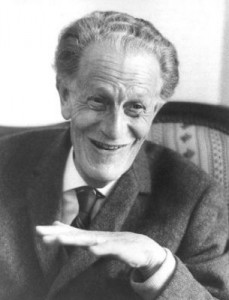
In 1902, an 11-year old Swiss lad, the son of a Calvinist minister, attended a performance in his native Geneva of J.S. Bach’s “St. Matthew Passion.”  So overcome was the musically and religiously sensitive young Frank Martin (whose name is pronounced in the French manner) that he decided on the spot to make music his life’s work, and Bach his model.  Over the next 72 years, right up to the year of his death, 1974,  Martin produced a large and fine corpus of works in many genres that places him among Ernest Bloch and Arthur Honegger as Switzerland’s foremost 20th century composers.

As Switzerland is poised between France and Germany, so does Frank Martin’s mature music combine Gallic and Teutonic elements:  the sensuous colors and clear textures of Maurice Ravel and Albert Roussel, the counterpoint of Bach and, starting around 1930, the twelve-tone technique of Arnold Schoenberg, albeit employed personally and without forsaking tonality.  In the taxonomy of 20th-century musical “isms,” Martin might be most easily classified as an exponent of neo-classicism, exemplified by his two masterpieces for chamber orchestra, the “Petite Symphonie Concertante for Harp, Harpsichord, Piano and Two String Orchestras” and the “Concerto for Seven Winds, Timpani, Percussion and String Orchestra.”  If you want to hear what neo-classicism sounds like, you can’t do much better than these two great works:

Elegance, unflagging invention, piquant but palatable harmonies, delight in unusual color combinations, both gravity and uplift — I love this music and hope you do too.

young martinolder martin

The chorus was a mainstay of Martin’s focus from first to last, and from shorter a cappella works to such large-scale oratorios as “Le vin herbé” (a 1940 telling of the “Tristan and Iseult” story for 12 voices and five-part chamber ensemble), “In terra pax” (a 1944 setting for large vocal and orchestral forces of Biblical passages on war and peace) and his valedictory 1972 “Requiem.”

Then there is the extraordinary choral work that Martin mostly composed in 1922, added the final section to in 1926 — then put in a drawer until finally allowing publication and performance in 1963.  What on earth would possess a composer to suppress for forty years as fine a piece as Martin’s “Mass for Eight Voices?”

Actually, the reason was not to be found on earth at all.  Rather, Martin considered the Mass to be a private matter between himself and his God, and did not want it to be judged on aesthetic rather than spiritual grounds.  Perhaps the shadow of Bach and his Passion also loomed over the young composer, still searching for his individual voice in his early thirties.

Whatever the motives, we can rejoice that Martin eventually relented, and allowed us to sing and hear one of the most beautiful a cappella Mass settings since the Renaissance.  Indeed, Renaissance touches abound, such as the modal melodies and ingenious writing for two choirs, sometimes combined, at other times separated and contrasted.  From simple melody to complex counterpoint (the weaving together of several musical line), Martin’s technical range is all-encompassing, but always, always, placed in the service of expression of the text.

To hear such a work from a recording (or a Spotify playlist), in the privacy of your own home, can be a deeply rewarding experience.  But to hear it sung by dozens of well-tuned voices, resounding in a beautiful sacred sanctuary, is something quite rare and special.  Allow me, then, to bring to your attention, a performance of Frank Martin’s “Mass for Eight Voices” and other works by the splendid Illuminati Vocal Ensemble, collaborating with the UMass Chamber Choir, conducted by Tony Thornton, Saturday evening in the sanctuary of the Newman Center at UMass Amherst.  It promises to be a lovely way to spend a fall evening engulfed in the warmth of the human voice and great music.

 

Albums du jour: Aphex Twin & Flying Lotus

aphex-twin-3

Look who’s got a new album out — the man who taught electronica how to energize the mind as much as the limbs.  Call it “Braindance” (a term he coined), IDM (“Intelligent Dance Music”) or whatever, the music of Aphex Twin long since escaped the boundaries of genre to take a prominent place in the wide, wonderful world of vital, relevant and, make no mistake about it, great music.

It’s been thirteen years between Aphex Twin full-lengths, making the release of “Syro” a cause for much rejoicing throughout the land.  So, what has this restless genius, one who exhausts the thesaurus for synonyms for “protean,” “chameleon” and the like, got for us after all this time?

Turns out to be neither reinvention nor regurgitation; instead, it’s a confident, mature artist putting his flag in the ground and reclaiming his kingdom, much as [PRETENTIOUS COMPARISON ALERT] the great tenor saxophonist Coleman Hawkins, returning home after several years in Europe, did with his celebrated “Body and Soul.”  The Boss is back!

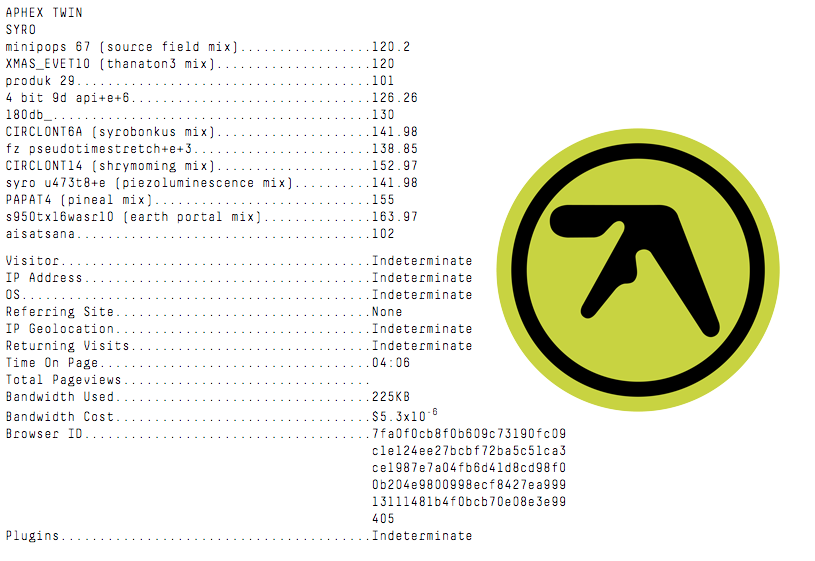
Back that is, with 65 mind-blowing, booty-shaking (did I just write that?) minutes of musical entertainment, good as he ever was.  There isn’t a thoughtless or uncared-for bleep in any of the dozen tracks; indeed, each of the approximately 200 (I stopped counting) electronic tools listed on the insert are all put to good use.  When you listen, for instance, to the funky riff that courses through track two, “XMAS_EVET10 (thanaton3 mix),” take note how many variations of line and tone are built in — and how much of a difference it makes.  The final track, “aisatsana,” makes for a surprising and touching epilogue, too.  Said it before, say it again:  This kind of artistry matters, and should be recognized and celebrated.

Flying-Lotus-Youre-Dead-1

So, who’s been at play while Aphex Twin has been away?  Oh, just such brilliant, ceaselessly creative electronica artists as (among many others) Burial, MatmosOneohtrix Point Never, Toro y Moi and, far from least, Flying Lotus, the artist behind a non-stop bullet train of an album called “You’re Dead!”

The music blends electronic sounds, samples, live instruments, singers, rappers and choirs into a cinema-of-the-mind narrative that, while never directly spelled out, seems to parallel the psychedelically violent guro manga (I had to look it up too) illustrations by Shintaro Kago that go along with each of the nineteen tracks.  Such notables in their fields as Herbie Hancock, Thundercat, Kendrick Lamar, Snoop Dogg, Jeff Lynne, Niki Randa and others whose names you may or may not recognize stop by for a track or two.  And as with the Apex Twin, the level of care taken with every element of the album is extraordinary — the tension doesn’t flag for a second.

So even, make that especially, if you’re new with this whole electronica thing, as I was until far too recently, take the time to find out what creative and very cool sounds have been happening while you were occupied elsewhere.  It’s what keeps us aging music lovers alert and alive, fully engaged with not just our beloved past but with the hopeful present.

Are live musicians always better?

Sweeney_WEB_icon

If you want to put a scowl on a musician’s face, bring up the issue of the increasingly frequent use of electronics to replace live musicians in music theater productions.  You’d better have your flame shields ready.

Who can blame them?  Playing music for pay is, to be tautological, the musician’s livelihood.  And to be no less obvious, decreased use of musicians means decreased opportunities for musicians.  No wonder that musicians have a bad attitude about this, and that their professional organizations speak out against it at every turn.

Just as obvious, of course, is why theater producers would consider such a practice: Costs.  Given the huge financial risks of live theater and already eye-popping ticket prices, who can blame them?  But oh, do they get paid back in ire and invective.  Sometimes, it gets so bad, with threats of ostracism and worse made against participating scabs — er, performers, that the whole production gets bagged.  That was the eventual outcome of a case I wrote about earlier this year.

So we know the position of the musicians, echoed by much of the musical press. After all, like the fans who demand that their favorite sports teams sign all the best free agent players, it’s not their money.  We know what the producers have on their mind, even if we don’t like it.  But how about we step out from the back of the house, take a seat in the audience, and listen with unprejudiced ears?  Sometimes, you might find, live musicians aren’t all they’re cracked up to be.

One such instance was Lyric Stage Company of Boston‘s otherwise superb production of Stephen Sondheim’s “Sweeney Todd: The Demon Barber of Fleet Street,” which The Wife and I attended on Sunday.  In his pre-curtain introduction, production director Spiro Veloudos made sure to congratulate his company for employing a real orchestra, and to invite the audience to applaud him, and themselves, for their enlightened stand on live musicians.  There was no question whose side the angels were on.  Then came the unseen conductor’s downbeat, and with it, a dose of reality.

For while the singing actors, all possessing fine, well-trained voices, performed with little or no amplification (what a treat!), they still overpowered the seven-piece instrumental ensemble, relegated to an offstage location due to Lyric’s very intimate performing space.  When you could hear the musicians, you heard some pretty scrawny and scrappy sounds, nowhere near weighty enough to provide the necessary oomph at climactic moments, of which the score has many.  And when the keyboards might have been expected to come to the rescue, as they often do in such situations, what we got was tinny, distorted and, frankly, unworthy of the professional level of the production.  I’m not assigning blame, I’m just describing what I heard.

Such an approach might barely have sufficed for a smaller-scale Sondheim show like “Company,” but for “Sweeney,” with its larger-than-life emotions and soaring, Puccini-esque vocal lines, it didn’t work at all.  (Remind me to tell you the story someday of how my late friend Fred Marks claimed to have introduced Puccini’s music to Sondheim, to whom Fred was distantly related.)

To my ears, some Plan B should have been considered, one that, while not busting the budget, would have done better justice to the show and to the paying audience.  Obviously, a full orchestra would have either broken the bank or launched ticket prices into the stratosphere — plus, there was nowhere to put it.  Maybe the seven-piece orchestration could have been better, but I don’t think that would made a decisive difference without additional instrumental firepower.  We were asked, practically commanded, to applaud Lyric Stage for its use of live musicians.  But in reality, the production did not make a very strong case for them.

So let me ask this modest question:  If at present, or in the future, a solution to the above dilemma could be found in better, smarter and cheaper electronic music technologies, and if it were to be found that they worked well and that audiences responded well to them, would musicians continue to stand in the way of such a solution?  That’s all I ask.

By the way, my next blog entry will probably be a review of new albums by electronic musicians Aphex Twin and Flying Lotus.  I hope I will not be besieged by angry emails from all the musicians put out of work by these brilliant artists’ use of electronics.

Album du jour: Steve Reich, “Radio Rewrite”

reich-radio-rewrite-450x400

By now, it seems as if every classical musician this side of James Levine has performed a song or two by Radiohead, the influential British band whose very name has become a signifier for all that is smart in contemporary rock music.  But if you’re still unaware of Radiohead, don’t feel bad.  So was Steve Reich, the great American composer, until 2010, when he met the band’s guitarist, Jonny Greenwood, at a festival on which Greenwood played Reich’s “Electric Counterpoint.”

Four years later comes the present album, containing not just Greenwood’s take on “Electric Counterpoint,” but a new Reich work based on two Radiohead songs.  First thing first:

One of several Reich works in which live performers play alongside multiple recordings of themselves, “Electric Counterpoint” has all the hallmarks of classic Reichian minimalism:  Surging and receding pulses, syncopated melodic fragments, multiple repetitions with gradually accruing variations (often analogized to time-lapse photography of a flower blooming), simultaneous out-of-phase iterations of identical (or near-identical) melodies…oh hell, just listen to the darned thing, first in jazz guitarist Pat Metheny’s orginal 1987 recording…

…then, from the Nonesuch Records page of the new album, in samples of Greenwood’s recording.  Quite a difference, yes?  In sound concept, Metheny plays amplified acoustic guitars while Greenwood plays electric guitars.  Metheny articulates the melodies with a jazz musicians’s swing, Greenwood with a rock musician’s drive.  I found Metheny’s to be more precise and Greenwood’s more euphoric and exciting, but the choice is yours.  Why not both?

If you’re still in the mood to compare multiple versions of Reich’s pulse-driven music — you can certainly wait til tomorrow if you’re not — here are Reich and friends performing his 1973 “Six Pianos”…

…which you can compare to pianist Vicky Chow’s live performance of the same piece, arranged by Vincent Corver for solo piano along with multiple recorded pianos (told you that a lot of his pieces did that) and re-titled “Piano Counterpoint”…

…and which you can sample at the Nonesuch album page in Chow’s recording on the new album.  Somehow, and please don’t ask me how, the piece has gotten progressively shorter from “Six Pianos” (24:00) to the live “Piano Counterpoint” (19:50) to the recorded “Piano Counterpoint” (13:44).  Your preference, then, may depend on whether, when it comes to Reich’s hypnotic piano writing, more is better, or less is more.

As for the new Reich work, it’s called “Radio Rewrite,” and is based on two Radiohead songs: “Everything in Its Right Place” (from the “Kid A” album) and “Jigsaw Falling into Place” (from “In Rainbows”).  In Reich’s words:

It was not my intention to make anything like ‘variations’ on these songs, but rather to draw on their harmonies and sometimes melodic fragments and work them into my own piece. As to actually hearing the original songs, the truth is—sometimes you hear them and sometimes you don’t.”

In his informative if somewhat worshipful album notes, Nico Muhly quotes Reich as likening this procedure to the many Renaissance masses based on the popular French melody “L’homme armé” (“The Armed Man”).  One could less pretentiously, if less prestigiously, have likened Reich’s piece to the thousands of Romantic Rhapsodies, Fantasies and other take-offs on popular operatic tunes (e.g., Pablo de Sarasate’s “Carmen Fantasy”), but whatever.

To be blunt, while there’s nothing at all wrong with “Radio Rewrite,” skillfully played by the chamber ensemble Alarm Will Sound, Alan Pierson, conducting, it doesn’t really add much to either Reich’s worklist or Radiohead’s discography.  Those who have heard their share of Reich (which I hope is everyone) won’t hear anything new in a piece which, if it were called “Something I Wrote for Alarm Will Sound,” without reference to its source material, would not be worth making a fuss over.  Neither should evoking Radiohead’s name on a classical album create much of a stir anymore. But that’s OK; when you’ve reached Reich’s status, not everything has to be a masterpiece.  For the present, it’s a good, timely listen, which certainly counts for something.  Happy birthday, Steve Reich, and many endlessly varied, slowly transforming returns of the day!

You can order the CD or a download here.  Don’t even try to go for an mp3, lest you be sentenced to wear an “I Like Crappy Sounding Music” t-shirt in public.

P.S. (Added on October 4, 2014):  Please permit a fallible critic — oy, is he fallible — to upgrade his opinion of “Radio Rewrite” after a few fresh listens.  Contrary to the above, there is something new in Reich deriving his materials from rock music.  They lend the three fast sections (marked just that, “fast”) a rhythmic solidity unlike anything you’ve heard up to that point on the album.  And two intervening slow sections (likewise marked as such) have a quality of human tenderness rare in Reich.  Speaking of “Radio,” this is one of the few Reich pieces I would have considered for my public radio classical show.  Any takers, old colleagues?


Album du jour: Sam Amidon, “Lily-O”

amidon-lily-o-450-409-500x500

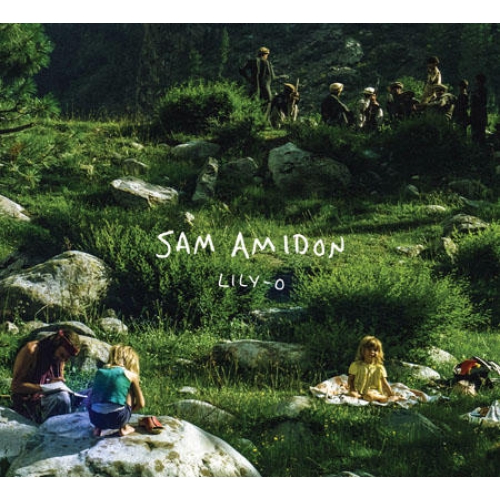
The son of Vermont traditional music luminaries, Sam Amidon is a born and bred folkie.  To judge from how natural-like he plays and sings, Amidon might well have literally grown up with a banjo on his knee and folk ballads on his lips.  That his accent is less Green Mountain than Appalachian should only trouble you if you’re also troubled when violinists who grow up in Shaker Heights or Seoul play Mozart in the authentic old Viennese spirit.  In other words, you shouldn’t be troubled at all.

I first came across Sam Amidon not in a folk setting, but in Nico Muhly’s “The Only Tune,” an electr0-acoustic fantasy on a folk ballad in which a miller makes a fiddle out of the remains of a young woman drowned by her sister.  In Muhly’s piece, Amidon plays a role similar to that of the balladeers in such works as Benjamin Britten & W.H. Auden’s operetta “Paul Bunyan” (hear a selection here) and in Stephen Sondheim’s musical “Assassins” (hear a selection here).  Check it out

The closest thing on Sam Amidon’s excellent new album “Lily-O” is the title song, another tragic tale of sibling murder.  Here, however, the inexorable tread of the song’s meter, coupled with the constantly shifting colors and harmonies of the accompaniment (after the a cappella opening) remind me not of Muhly, but of the remarkable folksong transformations of the Australian-American pianist-composer Percy Grainger.  Compare, for instance, Amidon’s “Lily-O” with one of Grainger’s most powerful folk-based works, “Shallow Brown”:

A dyed-in-the-wool folkie friend of mine once disparaged such Grainger works as “emasculations” of their source material.  I wonder whether, if she hears this one in a new light, she might reconsider?  But I digress.

Back to Sam Amidon, whose fourth album, and second for Nonesuch Records (the NPR of labels), is a treat for folk fundamentalists, snooty sophisticates (basically the same people in different dress), and the rest of us who respond to good music of any provenance.  Whether singing tunes of woe, work or worship, Amidon retains the affectless tone of traditional balladeers, a tone which would itself threaten to become an affectation if it didn’t sound so, well, unaffected.

Recorded in Reykjavik, like his first two albums (isn’t every cool album recorded in Iceland nowadays?), “Lily-O” is Amidon’s most intimate:  Just a quartet, with some instrumental doubling.  Of course, when your quartet contains Bill Frisell, he of the amazing technicolor dream-guitar, there’s no need for more than four.  Frisell’s panoply of twangs, bends, buzzes, beeps, harmonics and what-have-you provides shape-shifting underscoring, while the rhythmic support of bassist Shahzad Ismaily and drummer Chris Vatalaro are spot-on.  “Lily-O” may not bowl you over the first time, but I bet it will grow on you and improve with each hearing.

For instant gratification (is there any other kind?), you can order a CD or download (FLAC please!) directly from Nonesuch here.  And to preview on Spotify:


Album du jour: John Luther Adams, “Become Ocean”

4901795-origpic-eb457a

In Douglas Adams’s “The Hitchhiker’s Guide to the Galaxy,” we meet a gent named Slartibartfast, a Magrathean planetary designer with a specialty in coastlines.  When “Slarty” hears of the destruction of Earth, he laments in particular the loss of the fjord-etched coastline of Norway:

“Pity,” said Slartibartfast, “that was one of mine. Won an award you know. Lovely crinkly edges. I was most upset to hear about its destruction.”

Our friend Slartibartfast has a kindred artistic spirit in composer John Luther Adams.  A 61-year old long-time resident of Alaska (speaking of gorgeous coastlines), Adams works in sound the way Slarty worked in earth and water:  molding, shaping, layering, juxtaposing.  The normal primacy of the most human elements of music, melody and rhythm, is turned upside-down in Adams’s sound world, or as he puts it, his “sonic geography,” one in which timbre (tone-color) and texture predominate.

You can see by scanning the titles in his work list that Adams receives much of his inspiration from the natural environment.  His aim, however, is not to describe the environment for us.  It is to capture it for us in sound,  to make permanent something that may eventually be lost to us.  In this way, while he may also be thought of as classical music’s nearest equivalent to such masters of ambient music as Brian Eno and Aphex Twin,  John Luther Adams continues the line of impressionist composers that started with Claude Debussy, whose symphonic triptych “La Mer” (“The Sea”) inevitably comes to mind when listening to Adams’s latest orchestral masterwork, “Become Ocean.” Won an award you know: The 2014 Pulitzer Prize for Music.

Here’s John Luther Adams’s introductory note in the CD booklet:

Life on this earth first emerged from the sea. Today, as the polar ice melts and sea level rises, we humans face the prospect that we may once again, quite literally, become ocean.

That’s it.  No analysis, no road map, nothing.  Not that there couldn’t be, for as detailed by critic Alex Ross, complete with a fancy diagram, “Become Ocean” is a piece with a plan.  But as always — and especially in this case — your first hearing should take place before you have been told what you are supposed to hear.  In other words, listen first, read second, then listen again.  Not to give the game away, I’ll just say that “Become Ocean,” stunningly played by the Seattle Symphony, Ludovic Morlot conductor, is as haunting and thrilling a new piece of music, regardless of genre, as I have heard in some time.  And I very much want you to hear it too.

Here’s where you can purchase and download it (FLAC 16-bit or better, please).  You can preview it below on Spotify.  Enjoy!


Albums that were never du jour

doriscecil-taylor-02

Here’s a brief list of albums that, for one reason or another, never got made.  If you’re aware of others like them, please add them in the reply section.

A Very Fugs Christmas!

Albert Ayler Digs Cole Porter

Rudolf Serkin: The Complete Piano Music of Francis Poulenc

Sinead O’Connor & the Mormon Tabernacle Choir:  “Rock of Ages” and Other Favorite Hymns

Doris Day Sings!  Cecil Taylor Swings!

Twelve-Tone Music’s Greatest Hits

David Byrne:  The Spotify Special

Pete Seeger: Live at the Republican National Convention

Schubert: “Winterreise” (Luciano Pavarotti, tenor)

Bob Dylan:  The “Enough Already” Tour


The Lady and the Champ

Lady-Gaga-and-Tony-Bennett-for-Cheek-to-Cheek-5

The Wife and I have been enjoying Tony Bennett and Lady Gaga’s new duet album, “Cheek to Cheek” over the last week.  And what’s not to enjoy?  While no instant classic, “Cheek to Cheek” entertains crisply and consistently for 35 minutes, leaving plenty of smiles and no bitter aftertaste.

The repertoire consists of nine tunes drawn from the uppermost drawer of The Great American Song, along with two semi-novelties:  Eden Ahbez’s “Nature Boy,” done as a valse triste (and featuring a flute solo by the since-deceased Paul Horn), and Carolyn Leigh and Cy Coleman’s sprightly “Firefly,” an earlier hit for Mr. Bennett.

Anyone who grew up with TV variety specials would recognize the basic duet format deployed here:  I sing a line, you sing a line, then we harmonize.  The lyrics get updated in order for the singers to address each other by name, thus turning the whole thing into a festival of mutual admiration.  With fine arrangements mostly by Jorge Calandrelli, nice jazz contributions by Joe Lovano, Brian Newman, Mike Renzi, et al. and superb high-gloss production, “Cheek to Cheek” is one really classy affair.

As for the two stars, let’s get the most obvious questions out of the way.  Yes, Mr. Bennett, currently in his 89th year, remains in fine form.  He can still hit the high notes, still sustain a phrase, and still swing like crazy.  And yes, Ms. Germanotta can sing these songs very well.  She’s got the pipes (does she ever!) the style and the musicianship.  Now, one would hope that these could be said of anyone who ventures into the classic pop field.  Alas, we know it cannot — as I was saying to Rod Stewart just the other day.

For the most part, Lady G. matches Tony B. note for note, word for word, all along the merry way.  Where she doesn’t, it’s not so much for what she lacks.  It’s because when you step into the studio with Tony Bennett, it doesn’t matter who you are and how hard you try.  You will be outclassed.  To anyone who would complain that an album like this should be heard as a collaboration, not a competition, I would mostly agree.  But part of the fun of such music comes from the sport of two pros going at it, each spurring the other to his/her best.  Besides, with the album’s seventh and eighth songs, the producers have, intentionally or not, made sure that comparisons between the singers became inevitable.

The two songs in question have much in common.  Each comes from the early-to-mid thirties.   Each features an angular, wide-ranging melody that soars over rich, highly chromatic harmonies.  The lyrics of each delineate the plight of a lovelorn demimondaine for whom we are meant to feel some combination of empathy and disapproval.  Each emerges from the world of Ellingtonia, though one does so with an asterisk.  Each has been assayed by many of the greatest singers of the last 80 years.  And on “Cheek to Cheek,” each is done as a solo by one of the two singers, taking turns.

First up is Lady Gaga with “Lush Life,” composed by the teenaged Billy Strayhorn a few years before he joined the Ellington entourage as composer, arranger, assistant and sometimes pianist.  Clearly, the Lady gave considerable thought to her interpretative strategy, which consists primarily of coloring her voice to match the lyrical mood of the moment — here the girlish ingenue, there the world-weary chanteuse, and so on.  But most people don’t do this when they talk about themselves, do they?  No they don’t, but singers calling attention to themselves do.  Further, Gaga’s phrasing and enunciation fall short of impeccable, especially when she ascends into her somewhat squeezed  upper range.  Minor flaws like these might have remained inconspicuous in less revealing repertoire, but they stick out here.

Such quibbles may seem, well, quibbling.  But when you play in the big leagues, you’re going to be judged against the big leaguers.  And when your solo on “Lush Life” is followed by Tony Bennett’s solo on “Sophisticated Lady,” you had better bring your best.  Because Bennett’s rendition of Duke Ellington’s melody and Mitchell Parrish’s lyric, backed just by Mike Renzi’s piano, is so accomplished, so expert, such a work of art, that almost anyone by comparison will sound like a fumbling amateur.

Oh, the interpretive touches are myriad.  The way that Bennett subtly elongates certain words and phrases and slightly telescopes others.  How whenever a melodic phrase reappears, he gently alters it, for musical and dramatic flow.  There’s his perfect enunciation — somewhere, the late great Mabel Mercer is smiling.  Don’t you love the speech-song, or as the Germans call it, sprechstimme that Bennett uses after the piano interlude?  Not fancy or showy, but natural.  That word, natural, best describes for me the totality of Tony Bennett’s artistry here.  Nothing he does is imposed on the song from the outside; everything he does naturally emerges from inside the song. He’s not acting it, he’s living it.  I think I’ve listened to “Sophisticated Lady” over a dozen times already, and not only do I discern a new detail each time, I get chills each time.

I did not come here to bury Lady Gaga, but to praise Tony Bennett.  If there’s one thing I’d like you to take away from this blog entry, or any blog entry, is that artistry in music should never, ever, be taken for granted.  At its highest, and at its rarest, it should be listened for, recognized and cherished.  Bravo, Signor Benedetto!

Album du jour: A Far Cry, “Dreams & Prayers”

12368778-far-cry-dreams-prayers

What a great album.  Then again, anyone who attended either of this year’s Pioneer Valley concerts by the cooperative Boston-based chamber orchestra A Far Cry would have expected no less.  But can’t you recall cases where the magical spell cast by a concert failed to materialize from the “take-home version” of the same music?  I sure can.  Well, not this time.  While no recording can duplicate the real thing, a great recording can be a work of art unto itself.  This is one such case.

A major share of the credit for this goes to producer Jesse Lewis and to the recording venue, Sacred Heart Church, Fall River, Massachusetts.  The sound is warm and enveloping, while also being precise and frighteningly real.  Lo-fi enthusiasts, especially in classical music, please take note:  This is what you’re depriving the listeners and the music of.  Why?

Typically for The Criers (as the orchestra is also known), the intelligent program of selections was curated by one member, then vetted the entire membership.  In this case, violinist Miki-Sophia Cloud has put together a wide-ranging but cohesive selection of works which, in her words, “explores music’s role in religious mysticism as the ultimate passageway between the physical and the spiritual.  In each of the four works on the album, drawing on three faith traditions and 1000 years of history, something very simple — a breath, a word, a turn, a single note is transformed into something transcendent, and even holy.”

In that case, one just has to start with Hildegard von Bingen, the recently-canonized Medieval German abbess, poet, musician and mystic whose visionary hymns have been embraced by both the early music crowd and new music performers in recent decades.  The Criers’ own collective arrangement of Hildegard’s “O ignis spiritis paracliti” (“O spirit of fire, bringer of comfort”), played in awesomely unanimous unison by A Far Cry’s violinists, allows us to savor the simple perfection of an unadorned melody, shaped and inflected in ways almost too subtle to apprehend, but which are crucial to the narrative flow.  The word for this effect is: Musicianship.

Next was my introduction to the music of Mehmet Ali Sanlikol, a 40-year old composer, pianist and scholar on the faculties of Holy Cross and Brown, and with specialties in western classical, jazz, Turkish and “New Ottoman” musics.  His brief, effective “Vecd” (a state of rapture in Sufi mysticism) evokes the practice of the chanting of a mantra over an ostinato (repeated rhythmic pattern), each accelerating in tempo and intensity until a state of ecstasy is achieved.  Commissioned by A Far Cry, “Vecd” would fit nicely in the repertoire of other ensembles looking for a stimulating work with which to diversify their programs.

The mystical tradition moves from Sufism to Kabbalah in the next work.  Named for the 12th/13th-century Provencal Rabbi Yitzhak Saggi Nehor, , Osvaldo Golijov‘s “Dreams and Prayers of Isaac the Blind,” has become one of the most-performed works by the 54-year old Argentine-American composer, also on the faculty of Holy Cross.  A spectacular tour-de-force for klezmer clarinet, “Dreams & Prayers” gets an all-stops-out performance here by the amazing David Krakauer, who also made the first recording of the work’s original chamber version with the Kronos Quartet.  Fine as that was, I don’t mind saying that I substantially prefer this new version with larger performing forces, allowing for greater dynamic range while also softening the occasional stridency of the string writing of the original.

To express a similar preference for orchestration over original in the album’s final work would practically be sacrilege, even if I really felt that way.  But many of the legendary conductors, including Wilhelm Furtwängler and Arturo Toscanini, performed string orchestra versions of Ludwig van Beethoven’s late string quartets, so A Far Cry’s expansion of the “Heiliger Dankgesang” from the Op. 132 Quartet continues a distinguished tradition.  That movement, Beethoven’s “Holy Song of Thanks,” composed after recovery from serious illness, alternates between mystical hymn-like passages in a Medieval mode and more vigorous dance-like sections expressing renewed strength.

Kudos to The Criers for their sensitive decisions on when to maintain the intimacy of the original, and when to let the sound bloom with added instruments.  Their performance of the Beethoven no more supplants the original than would any fine cover version of a song off your favorite album.  But right up to the luminous final chord, Beethoven’s sublime, otherwordly song of thanks makes a moving conclusion to an album to reach for repeatedly, especially when in need of the spiritual sustenance great music provides.

For instant gratification, you can purchase and download the album in CD-quality or better (the only quality I permit my readers to purchase — no mp3s allowed!) here and here.  To preview on Spotify: