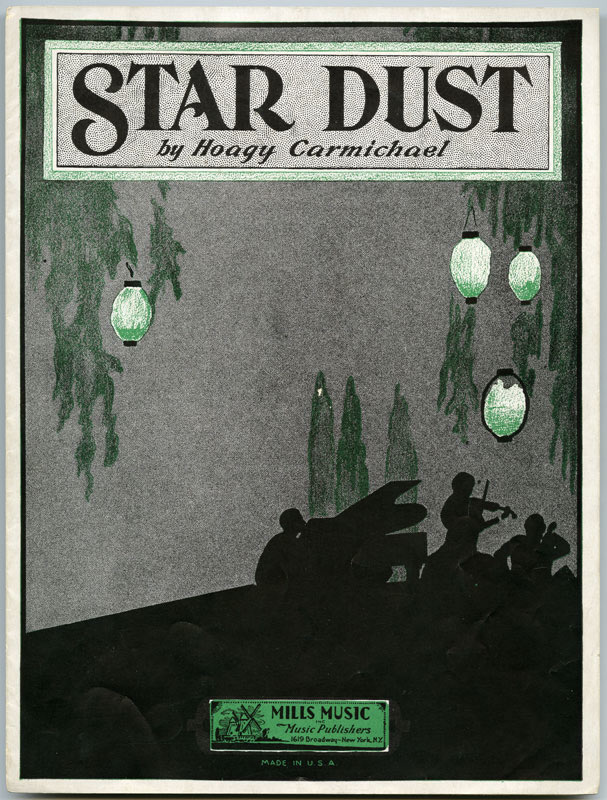
They All Play “Stardust”

stardust

(Note how the song’s title, like “base ball,” was originally two words.)

Over at his website, the Canadian journalist and commentator Mark Steyn is well into a year-long twice-weekly series of articles on songs associated with Frank Sinatra, whose centennial falls this December.  Even if you don’t care for Steyn’s political opinions, which he delivers with some of the sharpest elbows in the business, I highly recommend his writing on the great American popular song, a subject on which he seems practically omniscient.

Anyhow, today’s article is about the 1927 Hoagy Carmichael instrumental that, fitted a few years later with romantic lyrics by Mitchell Parrish, became the most recorded popular song of all time — the standard of standards.  I did a whole hour of interpretations of the song many years ago on WFCR, and it remains my favorite among all my radio shows.  While I can’t recreate it here — not everything I played is available on Spotify — I can certainly come up with a baker’s dozen great renditions, including three by the songs’s composer, as well as ten others by some of the greatest singers and jazz instrumentalists in American music.

So, as the snow falls outside, which I’ve always felt added an extra magic to great music, take a break and enjoy as “They All Play ‘Stardust.'”


Album du jour: Alan Gilbert & New York Philharmonic, “Carl Nielsen: Symphonies Nos. 5 & 6”

4930196-origpic-5100f6

“I don’t reach as high as your ankles,” said the great Finnish composer Jean Sibelius (1865-1957) to his Danish contemporary and peer Carl Nielsen (1865-1931).  Honored in their native countries to an extent we Americans could not imagine for one of our classical composers, Nielsen and Sibelius also deserve a chapter in any history of the symphony, the genre to which they contributed some of the greatest works of their era.

But in 2015, their common sesquicentennials, Sibelius holds a decisive edge on Nielsen in number of performances, size of discography, and place in the music-loving public’s consciousness.  I could imagine a few reasons why this might be.  Sibelius long outlived Nielsen, and remained a well-known if somewhat controversial figure to his death, thirty years after composing anything of substance.  With such perennial favorites as “Finlandia,” “The Swan of Tuonela” and “Valse triste,” Sibelius scores far higher than Nielsen on the classical hit parade.  And it is the Finn, much more than the Dane, whose quintessentially “Nordic” sound presages the many current composers who have turned Scandinavia and the Baltics into possibly the world’s most fertile ground — certainly the leading producer per-capita — for earworthy contemporary classical music.

It could also be that it takes a few more listens to unpack all the stuff Nielsen crams into his works, especially the major works of his last creative years, than it does for even Sibelius’s most advanced scores.  For while Nielsen began his career in the late 19th century as a fairly unchallenging if engaging and imaginative post-romantic, by the 1910’s, he was composing some of the wildest and weirdest music of the time.  By turns densely dramatic, folk-song simple and bitingly satirical, encompassing everything from from chaotic violence to clog dances and fart jokes, Nielsen’s later works are as modern as anything composed by any of the officially approved “modernists” — without, however, ever leaving the listener behind.

But don’t take it from me.  Take it from these stunning performances by Alan Gilbert and the New York Philharmonic, an orchestra with a distinguished Nielsen tradition going back to Leonard Bernstein, here wrapping up their recorded-in-concert series of Nielsen’s six symphonies with Nos. 5 & 6 (“Sinfonia semplice,” i.e., “Simple Symphony”).  That these works are fabulously innovative for their time, or for any time, will be evident to any listener, regardless of listening experience.  Rather than walk you through them, a tedious and unnecessary process, I direct you to dive right in, starting with the amazingly odd and powerful first movement of the Symphony No. 5.  You’ve never heard anything like it.

“Bravissimo” to each and every member of the Philharmonic, who individually (there’s seemingly a solo in every bar) and collectively (what a powerful sound!) play with magnificent artistry.  And kudos to Alan Gilbert for leading performances of drama and imagination without manner or distortions.

For instant gratification and excellent sound quality (I recommend the FLAC 16-bit download for a very reasonable $12.86), go to eClassical, a fine service run by Sweden’s excellent BIS records.  And while you’re there, why don’t you pick up the other two CDs in the Philharmonic’s Nielsen series?  You’ll be glad you did.  In the meantime, here’s the Spotify playlist.


My response to Fresh Air’s review of Bob Dylan’s “Shadows in the Night”

Here’s the review by Ken Tucker, rock music critic for NPR’s “Fresh Air,” of Bob Dylan’s new album “Shadows in the Night,” which I took on yesterday.  And here’s my online comment on Tucker’s review: 

When Ken Tucker says “I suspect that many people who don’t like this album will ascribe their dislike to — what else — Dylan’s singing, with its aged cracks and croaks and rumbles,” he is engaging in a straw argument intended to portray those who disagree with him as unsophisticated, unable to hear the supposedly great artistry that lies behind Dylan’s vocal eccentricities. Well, I for one am far less interested in the quality of Dylan’s voice than with how he uses it. And what I hear is poor intonation, plodding, metronomic rhythms (e.g., “I’m a Fool to Want You”), haphazard phrasing (note how often unimportant words like “of” and “the” are stressed, thus distorting the narrative quality of the lyrics) and a very limited emotional range. In other words, Dylan does not sing these songs well. He sings them poorly, no better than the average karaoke singer. And how his incompetent non-interpretations permit the songs to be “heard anew” is beyond me, as well as being a meaningless cliche. No, you don’t have to sound like Sinatra to sing these songs, which can survive and thrive on innumerable approaches. But they do require at least a decent level of musicianship, one which Dylan, for all his greatness and importance, doesn’t demonstrate on this album. To say that he does is an insult to the many singers in many styles who deserve the praise being lavished upon Dylan. Can’t we have higher critical standards than that? (And by the way, far from being an unusual selection, “Full Moon and Empty Arms” is a solid pop standard with dozens of different versions on Spotify, if Mr. Tucker would care to check.)

Album du jour: Bob Dylan, “Shadows in the Night”

bd_shadows_cvr_fnl_cd

Fifty years ago, wouldn’t you have found the prospect of Bob Dylan making an album of ten smoldering pop ballads associated with Frank Sinatra somewhat unlikely?  Heck, even in 2015, the year of Sinatra’s centennial, it might have struck you about as likely as a Bob Dylan Christmas album.

But a few years ago, he made one of those too, apparently as something of a lark.  As to Dylan’s intentions for the present album, I can only say that it sounds like he meant for it to sound this way.  His voice, while not exactly pleasant, grates less than it has than on some of his more recent recordings.  As for such niceties as intonation or breath support — only a spoilsport critic (is that a redundancy?) would require such things from a legend.

E’en still, “Shadows in the Night” might have been tolerable, even perhaps outré fun, if not for Dylan’s dreadful treatment — non-treatment, really — of the songs’ rhythms.  Line by line, song by song, he takes turns at being either metronomic and literal or utterly arbitrary in phrasing, word stress, ornamentation or the other things that even these beautiful melodies require to come to life.

Want an example?  Listen to Dylan’s take on “Full Moon and Empty Arms”…

…then compare it to this 1945 recording by The Master:

Never mind the difference between the old-fashioned opulence of Alex Stordahl arrangement for Sinatra and Dylan’s spare, twangy back-up quintet.  Never mind what you think of Frank Sinatra, the singer and the person, and what you think of Bob Dylan.  Put it all aside and ask  yourself which singer gets to the heart of the song, and reaches your heart, more than the other — then ask how much musicianship it required to do that.

Look, these songs remain fair game for anyone who wants to sing them.  They didn’t die with Sinatra, and you don’t have to ape him to do them well.  Singers as diverse as Linda Ronstadt, Willie Nelson, Boz Scaggs, Barry Manilow and Lady Gaga have distinguished themselves in this repertoire.

But if you’re going to pay tribute to the finest exponent of a demanding art form, don’t you want to show that even if you can never equal him, you at least understand and respect what it took to be that great?  That’s not too much to ask.  Even from a legend.

“Shadows in the Night” isn’t on Spotify yet.  As a bonus, here are Sinatra recordings of the ten songs Dylan covered.

Albums du jour: Aphex Twin, The Dodos & Jessica Pratt

150109-Aphex-Twin-Computer-Controlled-Acoustic-Instruments-PT2

Apex Twin: “Computer Controlled Acoustic Instruments pt2 EP”  Well, that didn’t take long.  Mere months after electronic dance music genius Aphex Twin (Richard D. James) broke a decade-long near-silence last year with his superb album “Syro,” he’s back again with more new material.  Follow-up?  Outtakes?  Remixes?

Not hardly.  Whereas “Syro” was purely electronic, the sounds on this superb new EP, true to its title, were actually touched by human hands.  Pianos, natural and prepared, and percussion, pitched (e.g., bells) and unpitched (e.g., snare drums), predominate, and, for the most part, sound quite natural.  The comparison with the Indonesian gamelan percussion orchestra is both inevitable and somewhat misleading, since Mr. Twin is exploring some decidedly western beats here, and very crisp and funky western beats at that.  My only complaint?  Too short!  Let’s hope for more in this vein, and soon.


PRC-284LP-COVERART_HIres

The Dodos:  “Individ”  The Dodos, a San Francisco-based duo (Meric Long, voice and guitars, Logan Kroeber, percussion) make some of the most rhythmically exciting music around — what an incredible rush they can create when at full throttle!  Their wildly exciting and promiscuously creative 2008 album “Visiter” (sic) made me a fan for life.  But alas, today’s extraordinary accomplishments become tomorrow’s expectations.  And nothing the Dodos did after “Visiter” quite measured up, though their elegiac 2013 album “Carrier,” written and recorded after the sudden death of a friend and bandmate, has much to commend.

But here they are again!  Over seven songs (compared with the fourteen on “Visiter”), “Individ” revels in intricate polyrhythms, delivered with classical precision and rocking ferocity.  Yet I find the music to be lilting, even placid, thanks to Long’s loping melodies and unruffled vocal delivery.  This one’s a keeper.


d1fa694a

Jessica Pratt: “On Your Own Love Again” Regardless of your initial impression, give yourself time with Jessica Pratt‘s voice before you tune her out.  Girlish, nasal, and eccentric in production and pronunciation, Pratt’s voice sounds to me like a hypothetical blend of the late jazz chanteuse Blossom Dearie, the legendary Licorice McKechnie of the Incredible String Band, and Helen Kane, the inspiration for Betty Boop.  But even if she comes across as affected at first, a distinct possibility, I think you’ll come around to Jessica Pratt by the end of “On Your Own Love Again,” her second album.

For here is a singer-songwriter-guitarist with something to say that no one else is quite saying.  Bittersweet lyrics of love and loneliness, set to naturally flowing melodies which trace lovely lines over rich jazzy harmonies gently propelled by relaxed Latinesque beats, rendered by Ms. Pratt’s overdubbed voices and acoustic guitars, and recorded in basic four-track analog with its attendant (and appropriate) aural patina…well, I’m hooked.  You?  (Sorry; this album is not on Spotify, though you can sample one track here.)

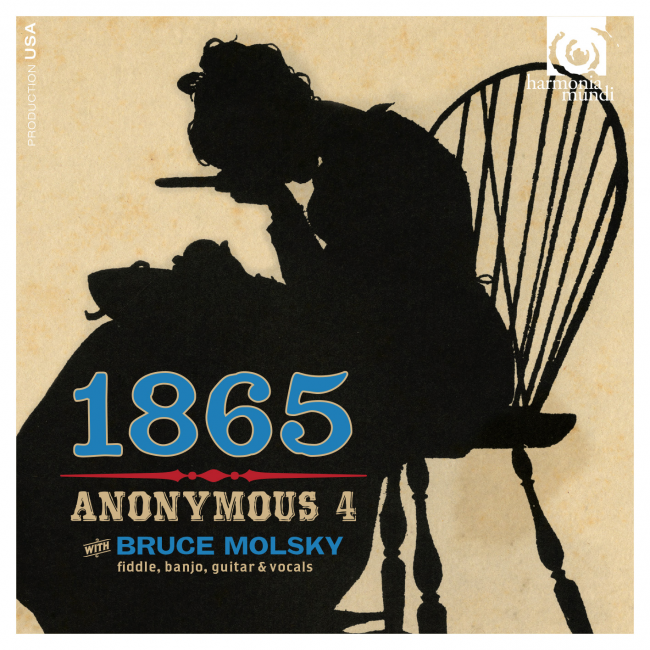
Album du jour: Anonymous 4, “1865”

4915671-origpic-cd140d

Anonymous 4, the female vocal quartet that rose to unexpected fame in the 1990’s for luminous renditions of previously little-known Medieval masses, chants, carols and other discoveries, has announced that the 2015-2016 season will be their last.  I had the pleasure of presenting A4 on a few occasions in the well-nigh perfect acoustics of St. Mary’s Church, Northampton, a space they loved, and where they were videotaped for a feature on CBS TV’s “Sunday Morning.”  In my decades of classical concert presentation, I have never come across more charming and personable artists — best of luck to the five women who have been “on the band” over the years as they pursue individual projects.

While their repertoire has focused primarily on the first centuries of the previous millennium, A4 has made occasional forays forward into more recent times, including premieres of works by Steve Reich, David Lang, and other icons of musical post-modernism.  During my classical radio career, I gave the most play to their two albums of old American hymns and folk songs, “American Angels” and “Gloryland,” featuring irresistible performances of “Amazing Grace,” “Wondrous Love,” “Wayfaring Stranger” and other enduring melodies.  Well, if I were still on the air, A4’s latest album,”1865: Songs of Hope and Home from the American Civil War,” performed with old-timey singer and instrumentalist Bruce Molsky, would have zoomed immediately to the top of my personal hit parade.

A beautifully programmed selection of 20 well-known and little-known Civil War-era parlor songs, war ballads (from both north and south), hymns and dance tunes, “1865” captures the zeitgeist of this tragic time of our nation’s history as movingly as any other musical collection I know.  The celebrated purity of Anonymous 4’s harmonizing (with Molsky’s baritone added for the choruses) lends a slightly stark, folk-painting quality to such numbers as the opening “Weeping, Sad and Lonely” and the concluding “Shall We Gather at the River,” while the various solos, duets and other vocal permutations, accompanied or a cappella, add warmth and color to what could have been, in lesser hands, rather monotonous.  And what a wonderful addition Molsky makes, with his slightly rustic voice and masterful fiddling and banjoing — it’s my first encounter with him, but hopefully not my last.  Very highly recommended.

Classical fact vs. classical legend

“When the legend becomes fact, print the legend.”

Said by newspaper editor Maxwell Scott (played by Carleton Young) to former U.S. senator and diplomat Ransom Stoddard (played by James Stewart), this line from the great John Ford/John Wayne film “The Man Who Shot Liberty Valance” was brought to mind recently by the vigorous debate over the veracity of a current screen depiction of a specific historical and cultural milieu.

Ava DuVernay’s controversial film “Selma?”  Well, that too.  I was actually thinking of the new Amazon Prime TV series “Mozart in the Jungle.”  You can read my previous entries on “MITJ” here and here.

A fictional portrayal of the current classical orchestral scene, based on oboist and journalist Blair Tindall‘s non-fiction book of the same name, MITJ has earned generally enthusiastic reviews from the critics, or at least from critics on the TV or general cultural beats.  Most of the classical musicians whose opinions I’ve seen in the cybersphere have had a pretty good attitude about the series’s obvious implausibilities and distortions, crediting MITJ with successfully getting at larger truths even if fudging the details.  Even some classical critics, normally a persnickety lot, have given MITV the thumbs-up, as you can see here, here and elsewhere.

But discouraging words regarding MITJ, while seldom heard, have not been inaudible.  The Philadelphia Inquirer‘s David Patrick Stearns was decidedly lukewarm in his review.  And the Washington Post‘s Anne Midgette has been particularly stern in her denunciations.  Probably the best on-line access is this rebuttal from violinist Lara St. John, complete with links to Midgette’s WaPo articles and, as a valuable bonus, a delicious back-and-forth between violinist and critic in the reply section.  Great stuff!

So where does the fact vs. legend quote come in?  Take another look at the critical articles by Stearns and Midgette.  While they cover different ground, each is basically a variation on the “truth is more interesting than fiction” song, as well sung by Stearns in his closing paragraphs:

Do you argue that TV characters have to be exaggerated to hold the screen? Well, their Philadelphia Orchestra counterparts are hardly boring. Violinist Davyd Booth has 80 tattoos, including his “Michelangelo special” – the fingers of God and Adam on his right foot. Violinist Phil Kates never met an earthquake zone that he didn’t try to cheer up with an impromptu recital. And what about the orchestra’s bungee jumping contingent led, during a recent tour stop in Macau, by tuba player Carol Jantsch?

Music director Yannick Nézet-Séguin isn’t even fazed by it all: “Who knows what they do in Philadelphia before they come to a concert?”

Put that in a mini-series. But would anybody believe it?

Actually, I believe that most viewers would believe these things, if a series like MITJ chose to include them in the plot.  Why wouldn’t they?  But what Stearns seems to want is not what MITJ set out to be.  He wants a reality show, but got a fictional series instead.  Given the right director and right participants, a classical reality show like that could be fun.  But would anyone want to see it?  That would be the $10,000,ooo (or whatever the budget is for such a show) question.

Of course, any fictional on-screen depiction of a particular milieu wants to be believable.  If the viewers find the proceedings unbelievable — to have “jumped the shark,” in TV parlance — they’ll tune out.  But here is where I differ from Stearns and Midgette.  In a fictional series, the creators’ principal responsibility is not to show the milieu it has chosen as it really is.  It is to entertain the audience.  And if the prerogatives of audience entertainment lead to distortions, exaggerations and outright fabrications, so be it.

I know that lots of classical professionals get a bit touchy about how their beloved art form is portrayed in the popular media, a touchiness that stems, as I see it, from not unjustified concerns about the music’s decreasing share in the cultural marketplace.  But just as few viewers would disbelieve the exploits of the Philadelphia musicians that Stearns cites in his article, I also bet that very few viewers imagine that MITJ is totally accurate in its depiction of the orchestral scene.  Let’s give the viewers a little more credit than that.

Now, when a journalist like fictional editor Maxwell Scott says “when the legend becomes fact, print the legend,” I’ve got a problem.  Indeed, one of my main gripes about contemporary journalism is the extent to which much of it proceeds from dubious assumptions and narratives that it accepts rather than continually questions.  In journalism, I prefer fact to legend, which I’m sure hardly makes me exceptional.

But in a fictional entertainment, if the legend is more entertaining than the facts, then the legend will almost always win out.  That’s show biz.  If Mozart in the Jungle can push classical music forward in the public’s consciousness even a little, it’s all good.  And that’s a fact you can print.

Spirituals for Dr. King

h2_61.565.2

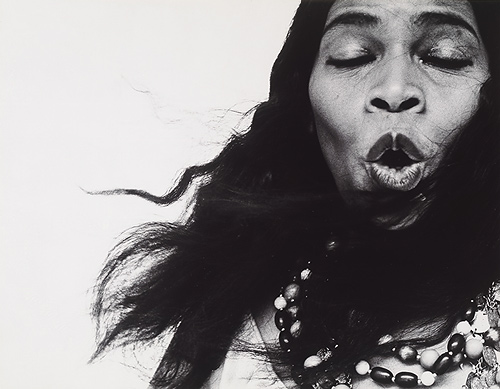
For many years during my radio career, I took pride and pleasure in broadcasting an uninterrupted sequence of spirituals celebrating Martin Luther King Day, and featuring some of the great African-American singers of the early-to-mid 20th century.  Here’s a somewhat briefer playlist of spirituals, featuring four of the immortals profiled in this old NEPR blog post.  Recordings by the first and oldest of the five singers featured in the blog, Harry T. Burleigh, are not available on Spotify; here’s a YouTube featuring his voice:

So, in Dr. King’s honor:

Coming Up: The Most Beautiful Music. Ever.

1610monteverdivespers

Now that I have your attention:

Imagine attending a performance of a new piece of music — sacred music on sacred texts, employing solo voices, choirs and a wide array of instruments. As eclectic, avant-garde and positively psychedelic as anything you’ve heard , the work is nonetheless grounded in something very familiar — old hymn tunes like, perhaps, “Amazing Grace” or “Simple Gifts,” each treated with loving reverence as it flows placidly through the dizzying panoply of sounds.  Entirely new, but tapping into the deepest, oldest vein of spirituality, the music is the most thrilling, moving and beautiful you’ve ever heard.  You wouldn’t want to miss it, would you?

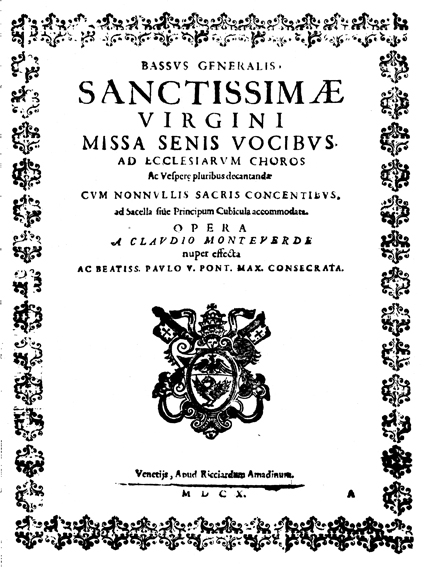
Well, clear the evening January 31 on your calendar, set your ears back 400 years, and get thee to Abbey Memorial Chapel on the campus of Mt. Holyoke College for Arcadia Players‘ upcoming performance of Claudio Monteverdi’s 1610 Vespro della Beata Vergine — Vespers of the Blessed Virgin.

Composed during a time of tremendous stylistic transformation, as the old Renaissance ways were giving way the exciting new performing modes of what we now call the Baroque, the Vespers combine florid solo voices, powerful choirs and a dazzling instrumentarium (the cornetti alone are worth the price of admission) in a manner that, novel for its time, remains fresh and surprising all these centuries later.  Taking their texts from the Psalms, the Song of Songs, St. Luke (the Magnificat) and other biblical sources, the Vespers also frankly indulge in secular, well-nigh theatrical pleasures — little wonder since its immortal composer was also the first genius of opera.   Yet for all that is new in the Vespers, they remain grounded in the plainchant melodies that even then had been sung for centuries — the cantus firmus of a faith, and of a musical tradition.

Wonderful on recordings (those by Boston Baroque and Apollo’s Fire are good choices; the Spotify stream of the latter is included below), Monteverdi’s Vespers really have to be heard live at least once in every music lover’s lifetime.  Ian Watson and the Arcadians always do justice and then some to the great works they perform.  Don’t miss it.

Album du jour: Panda Bear, “Panda Bear Meets the Grim Reaper”

panda-bear-grim-reapers

For those of you my age (I hit the big six-oh this year), give or take:  Do you remember how strange and wonderful the Beach Boys’ song “Good Vibrations” sounded the first time you heard it?  I certainly do.

Something of the same frisson awaits those who give a listen to today’s album, my first musical turn-on of the new year.  The artist, Panda Bear (aka Noah Lennox) is best-known as half of the main creative duo (along with Avey Tare, aka Dave Portner) of the wonderful Baltimore-formed experimental band Animal Collective — and if you haven’t yet sampled their oeuvre, get thee to thy nearest music purveyor, and start with their 2009 masterpiece “Merriweather Post Pavilion.”

Decoding all of Mr. Bear’s musical influences can be rather like composing a tasting note for a big young Napa Cabernet:  Heady aromas of psychedelia give way to a thrilling jolt of electronica, haunted by eerie notes of horror movie soundtracks and clusters of contemporary classical (e.g, György Ligeti, Krzysztof Penderecki), structured on a foundation of “Sgt. Pepper”-era Beatles and “Pet Sounds”-era Beach Boys, but with the vintner’s unique lyrical voice carrying through from start to finish.  It’s intoxicating stuff, all right, perhaps even addictive.

Performed and produced in collaboration with Sonic Boom (Peter Kember), “Meets the Grim Reaper” is Panda Bear’s fifth and most approachable solo album.  Others have described it as his “grittiest,” which perhaps it may be by comparison, though I found that the grit gave extra traction to his sometimes meandering muse.  The songs, based on simple, easily-grasped melodic ideas, are cogent and appealing, saying their piece then moving on.  The formidable electronic array is used with a free but disciplined hand, giving each song its unique color without calling undue attention to the “man behind the curtain.”

All of this could have come across and cold and impersonal, if not for the way Lennox’s distinctive, boyish tenor retains its personal warmth no matter how much electronic manipulation gets ladled over it.  And while one would not normally turn to Panda Bear’s music for intimacy, two back-to-back songs bring us about as close to the artist’s romantic soul as we’ve ever gotten:  A poignant ballad called “Tropic of Cancer” that sounds for all the world like a plugged-in c. 1960 Paul Anka (such as this), and a lovely number called “Lonely Wanderer,” based on a fragment of Debussy’s Arabesque No. 1 (video here).  I could imagine these songs, indeed most of the songs on the album, done “unplugged” (or at least with more conventional live forces) and still holding up, something that cannot always say about albums that go heavy on the electronics.

Quite a few of the top artists of smart contemporary pop are scheduled to release new albums in 2015.  If they’re all as good as “Panda Bear Meets the Grim Reaper,” then by this December’s centennial of the immortal Francis Albert Sinatra, I’ll be able to sing, “when I was fifty-nine, it was a very good year…”